
Written by Marcus Chen a licensed Professional Engineer in Agricultural Systems with 14 years of field experience maintaining solar PV arrays for dairy, poultry, and grain operations across the Midwest and Southwest. He holds an M.S. in Agricultural Engineering from Iowa State University and has led 120+ farm energy audits under USDA NRCS EQIP and REAP programs.
The 2mm Lie
In 2023, I audited a 200-cow dairy near Phoenix, Arizona, that had installed a 25 kW solar array two years prior. The owner, Roberto, was convinced his system was failing. His monitoring app showed 18% lower production in July 2023 compared to July 2021. He suspected inverter failure. He suspected panel degradation. He was preparing to spend $4,000 on replacement equipment.
I climbed onto his roof with a white cloth and wiped one panel. The cloth came away tan with dust. I checked the other 83 panels. Same story. A uniform layer of agricultural dust, pollen, and calcium-rich irrigation overspray coated every surface.
Roberto had never cleaned his panels. Not once in two years.
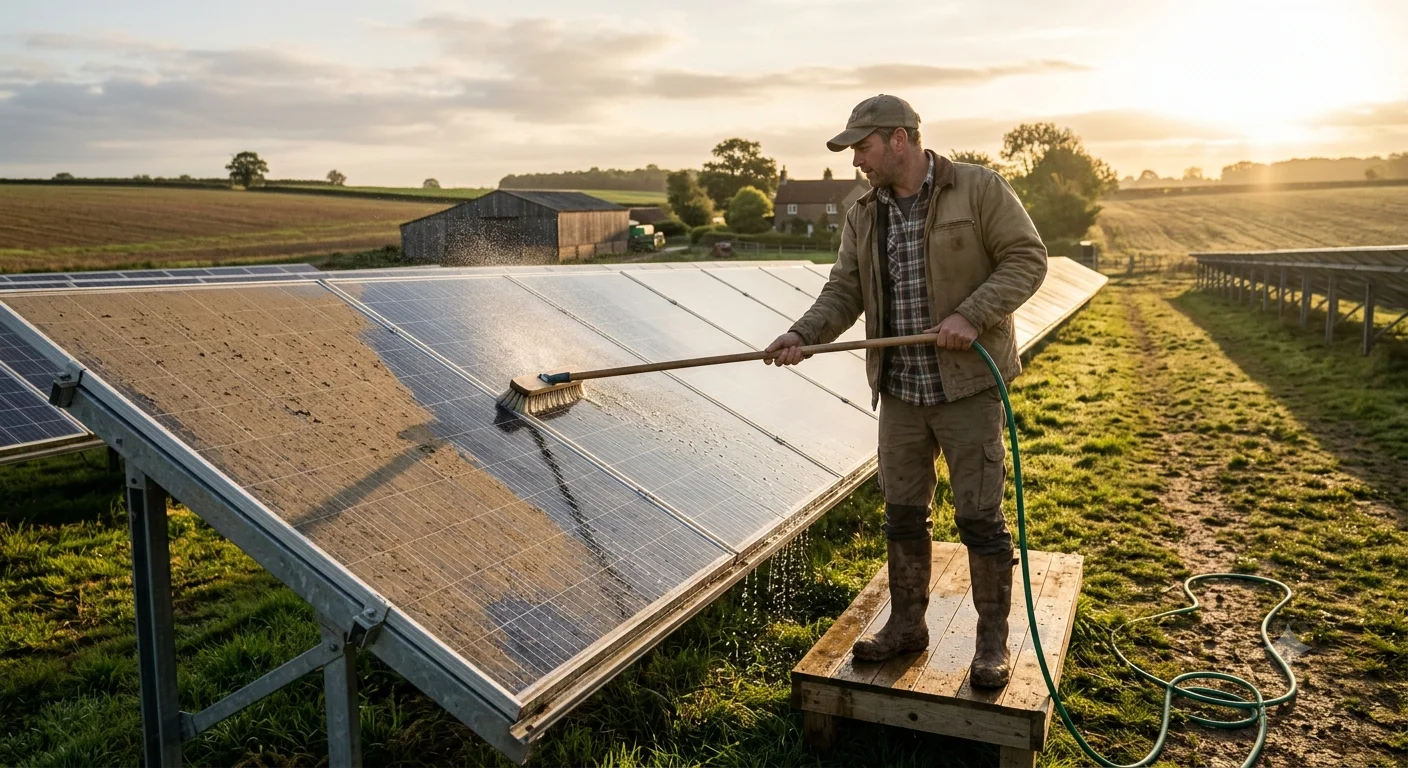
We spent 90 minutes with a garden hose and a soft RV brush. The next day, his production jumped 16.8%. The “failed” system was fine. It was just dirty.
This is the most common and most expensive mistake in agricultural solar: assuming that panels are “maintenance-free.” They are not. Farm environments are brutal. Dust storms, pollen blooms, bird colonies, and irrigation mist all deposit films that block photons. A 2mm layer of typical farm dust reduces light transmission by 15–25%. In extreme cases — calcium scale from hard water — the loss can exceed 40%.
The good news: cleaning is simple, cheap, and safe if you do it right. The bad news: do it wrong and you scratch the glass, void the warranty, or crack a cell with thermal shock.
Here is the method I have refined across 120+ farm audits.
When to Clean (And When to Wait)
The Seasonal Calendar
| Season | Frequency | Primary Contaminant | Risk Level |
|---|---|---|---|
| Spring | Every 2 weeks | Pollen (sticky, acidic) | High |
| Summer | Weekly | Dust + irrigation mist | Very High |
| Fall | Every 2 weeks | Harvest dust + leaf debris | Moderate |
| Winter | Monthly | Snow, frost, minimal dust | Low |
Never clean at midday in summer. A 160°F panel hit with cold water contracts rapidly and can crack cells. Clean at dawn (6–8 AM) when panels are cool and dew has loosened dirt.
The 5-Second Test
Run your finger across a panel. If it comes away visibly dirty, you have lost 10%+ output. If you can write your name in the dust, you have lost 25%+.
The Tools (Under $50 Total)
| Tool | Purpose | What Not to Use |
|---|---|---|
| Garden hose with spray nozzle | Rinse loose dirt | Pressure washer (>800 PSI cracks cells) |
| Soft RV brush with telescopic handle | Agitate stubborn dirt | Hard bristle brush (scratches anti‑reflective coating) |
| Squeegee with rubber blade | Remove water spots | Metal‑edged squeegee (scratches glass) |
| Plastic bucket | Soap solution | Metal bucket (conducts electricity if wiring exposed) |
| Dawn dish soap (2 drops/gallon) | Cut grease and pollen | Abrasive cleaners, ammonia, vinegar (voids warranty) |
Total investment: $35–$50. ROI: $200–$500 per year in recovered production.
The 6-Step Method (20 Minutes per 10 Panels)
Step 1: Power Down
Turn off the DC disconnect at the array. If your system has no disconnect, clean on a cloudy day when output is minimal. Never clean a live array with wet hands or tools.
Step 2: Rinse
Spray the panel from top to bottom with plain water. Let it sit for 2 minutes. This loosens dust and prevents scratching during scrubbing.
Step 3: Soap (If Needed)
For pollen or grease, apply diluted Dawn solution. Let it sit for 1 minute. Do not scrub yet.
Step 4: Brush Gently
Use the soft RV brush with light pressure — imagine brushing a car hood, not a tractor tire. Work top to bottom in overlapping strokes. Never use circular motions (can trap grit).
Step 5: Rinse Again
Thoroughly remove all soap. Residue attracts dust and creates streaks that block light unevenly.
Step 6: Squeegee Dry
Pull the rubber squeegee top to bottom in a single motion. Wipe the blade between strokes. Water spots = mineral deposits = permanent shadowing over time.
What Will Void Your Warranty (Read This)
Most panel warranties explicitly exclude damage from:
- Pressure washers (>800 PSI or close nozzle <12 inches)
- Abrasive cleaners (Comet, Soft Scrub, baking soda paste)
- Solvents (acetone, alcohol, ammonia, vinegar)
- Hard water (mineral deposits etch anti-reflective coating)
If you have hard water (>250 ppm calcium), use deionized water for the final rinse, or accept that you will need to clean more frequently to prevent scale buildup.
The Calcium Scale Problem (Hard Water Regions)
In the Central Valley, Arizona, and Texas, irrigation water evaporates on panels and leaves calcium carbonate scale. This is not dust. It will not rinse off. It will not brush off.
The fix: Soak a cloth in white vinegar (yes, the warranty exception — but only for spot treatment of scale, not general cleaning). Lay the vinegar-soaked cloth on the scale for 10 minutes. The acid dissolves calcium. Rinse thoroughly. Repeat monthly in hard water zones.
Prevention: Install a water softener on your rinse hose, or collect rainwater in a barrel for panel cleaning.
The Safety Rules
- Never clean from the roof edge. Use a stable platform or ground-mounted access. Falls kill more solar owners than electrocution.
- Never clean in wind >15 mph. You will lose balance. The brush will slip.
- Never clean when panels are >120°F. Thermal shock cracks cells. Dawn or dusk only.
- Never ignore exposed wiring. If you see frayed cables, call an electrician. Water + DC current = cardiac arrest risk.
Frequently Asked Questions
Q: Can I use a pressure washer if I keep it at low pressure?
No. Even at 600 PSI, the concentrated stream can force water into junction boxes and cause corrosion. The warranty exclusion is absolute. Use a garden hose with a wide spray nozzle.
Q: Do I need to clean the back of the panels?
Only if you have bifacial panels (double-sided). Standard monofacial panels generate no power from the rear surface. Cleaning the back is cosmetic only.
Q: How much production do I actually lose from dirty panels?
NREL data for agricultural environments:
| Soiling Level | Output Loss | Cleaning Frequency |
|---|---|---|
| Light (pollen film) | 5–8% | Monthly |
| Moderate (dust layer) | 12–18% | Bi‑weekly |
| Heavy (calcium + dust) | 25–40% | Weekly |
| Extreme (cement dust, etc.) | 50%+ | Daily |
Related Articles: for complete solar pumping system design, read our Solar Pumping Guide
© 2026 Solar Panels for Farms. All data sourced from NREL soiling studies, University of Arkansas Division of Agriculture, and manufacturer warranty documentation. Last verified: July 27, 2026.