
The Formula
Battery Capacity (Ah) = (Daily Load Wh × Days of Autonomy) ÷ (Battery Voltage × Depth of Discharge × Efficiency)
Where:
- Daily Load Wh: Sum of all your equipment’s daily energy use
- Days of Autonomy: How many cloudy days you want to survive (2 is standard)
- Battery Voltage: 12V, 24V, or 48V (use 48V for anything >1kW)
- Depth of Discharge (DoD): 80% for lithium, 50% for lead-acid
- Efficiency: 90% for lithium, 85% for lead-acid
Real Example: Haverhill Dairy
Dave and Lisa Haverhill run a 240-cow dairy in western New York. Their milk house and parlor operate on a hybrid solar-grid system. They wanted to take the entire milking center off-grid: parlor vacuum, milk cooling, barn lighting, and ventilation fans.
We audited their loads for a typical September day:
Calculation:
- Daily load: 30,000 Wh
- Days of autonomy: 2
- Voltage: 48V
- DoD: 80% (LiFePO4)
- Efficiency: 90%
Battery Ah = (30,000 × 2) ÷ (48 × 0.80 × 0.90) = 60,000 ÷ 34.56 = 1,736 Ah
That is a massive battery bank. Dave’s budget could not handle 1,736Ah of lithium. We made two adjustments:
- Reduced autonomy to 1.5 days (36 hours) for non-critical loads
- Kept the milk cooler on grid backup (its largest single load)
Revised load without milk cooler: 22,500 Wh/day
Revised battery: (22,500 × 1.5) ÷ (48 × 0.80 × 0.90) = 977 Ah
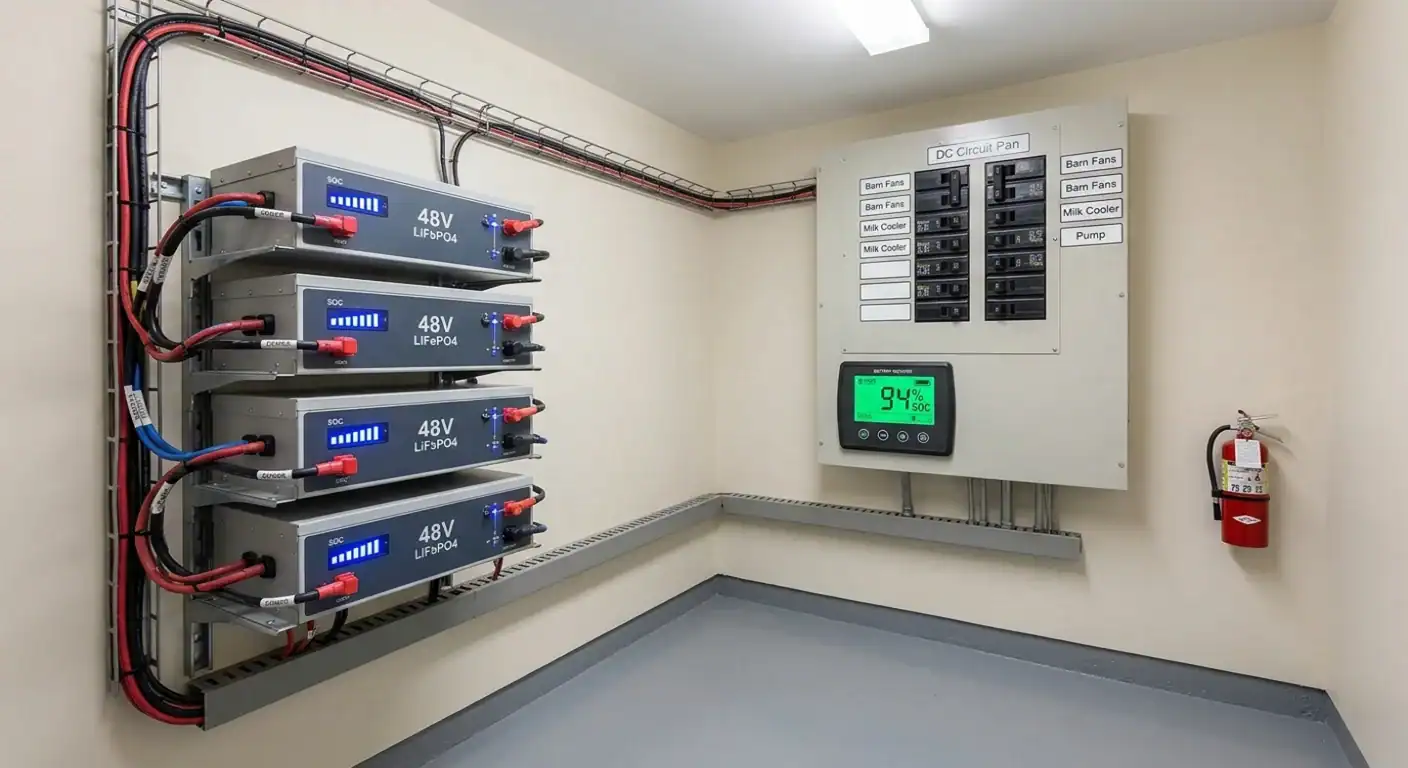
Dave installed 1,000Ah of LiFePO4 (twenty 48V 50Ah modules in parallel strings). The milk cooler runs on grid power during normal operations. During outages, the battery runs everything else for 36 hours.
Total cost: $18,500 for batteries + $4,200 for installation.
Annual grid savings: $2,400 (parlor and ventilation loads).
Payback: 9.5 years on energy savings alone. But Dave values the outage protection — he lost a $6,000 milking shift during a 2023 ice storm.
The 2 Sizing Mistakes That Destroy Batteries
Mistake 1: Using a 12V System for High Loads
A 1,000W load at 12V draws 83 amps. At 48V, it draws 21 amps. Same power, 4x less current.
High current requires massive cables, creates voltage sag, and generates heat in the battery terminals. A 12V battery running 80+ amps will have hot spots that degrade cells unevenly.
Rule: If your daily load exceeds 2,000Wh, use 48V. No exceptions.
Mistake 2: Discharging Lead-Acid Below 50%
A lead-acid battery discharged to 80% DoD will survive 200 cycles. At 50% DoD, it survives 800 cycles. At 30% DoD, 1,500 cycles.
If you size a lead-acid battery for 80% DoD “because the math works,” you will replace it in 18 months. Size it for 50% DoD and it lasts 5 years. The extra upfront cost pays for itself.
Battery Chemistry Comparison for Farms
| Chemistry | Upfront Cost | Cycle Life | DoD | Best For |
|---|---|---|---|---|
| Lead‑Acid (AGM) | $200/kWh | 800 @ 50% | 50% | Small systems, backup power |
| Lead‑Acid (Gel) | $250/kWh | 1,000 @ 50% | 50% | Moderate systems, cold climates |
| LiFePO₄ | $500/kWh | 4,000 @ 80% | 80% | Daily cycling, high loads |
| LiFePO₄ (cold‑rated) | $650/kWh | 4,000 @ 80% | 80% | Unheated barns, sub‑freezing |
For farm equipment that runs daily, LiFePO4 is the only rational choice. The upfront cost is 2x, but the cost per kWh over 10 years is one-third of lead-acid.
The “2-Day Rule” vs The “Generator Rule”
You have two philosophies for autonomy:
2-Day Rule: Size for 48 hours without sun. Accept no generator. Cost: high. Reliability: absolute.
Generator Rule: Size for 24 hours. Add a small generator for extended storms. Cost: moderate. Reliability: 95%.
Most commercial farms choose the Generator Rule. A $800 generator that runs 20 hours per year is cheaper than $4,000 of extra battery capacity that sits unused.
Related: Learn how to integrate battery storage into complete systems in our guides on Solar Attic Fans, Swine Ventilation, and Milk Cooling.
© 2026 Solar Panels for Farms. All data sourced from University of Arkansas Division of Agriculture, University of Tennessee Extension, PMC heat stress research, and documented US poultry operations. Last verified: July 20, 2026.