
Written by Dr. Robert Kowalski — Ph.D. in Agricultural and Biological Engineering from Penn State University, with 18 years of experience in on-farm energy systems. He has assessed both wind and solar installations for farm operations across the Midwest and Northeast. He is a licensed Professional Engineer and a member of the American Society of Agricultural and Biological Engineers.
A small wind turbine over the barn is the most romantic image in farm energy — and one of the worst investments. In nine out of ten farm assessments, solar wins decisively on cost, reliability, and maintenance. But not ten out of ten. Here is the physics, the rule that decides everything, and the three situations where wind genuinely earns its tower.
The Problem
Wind energy obeys a cruel equation: power scales with the cube of wind speed. Double the wind, get eight times the power. The mirror image is what kills small wind: at the typical farm’s measured wind speeds, output collapses.
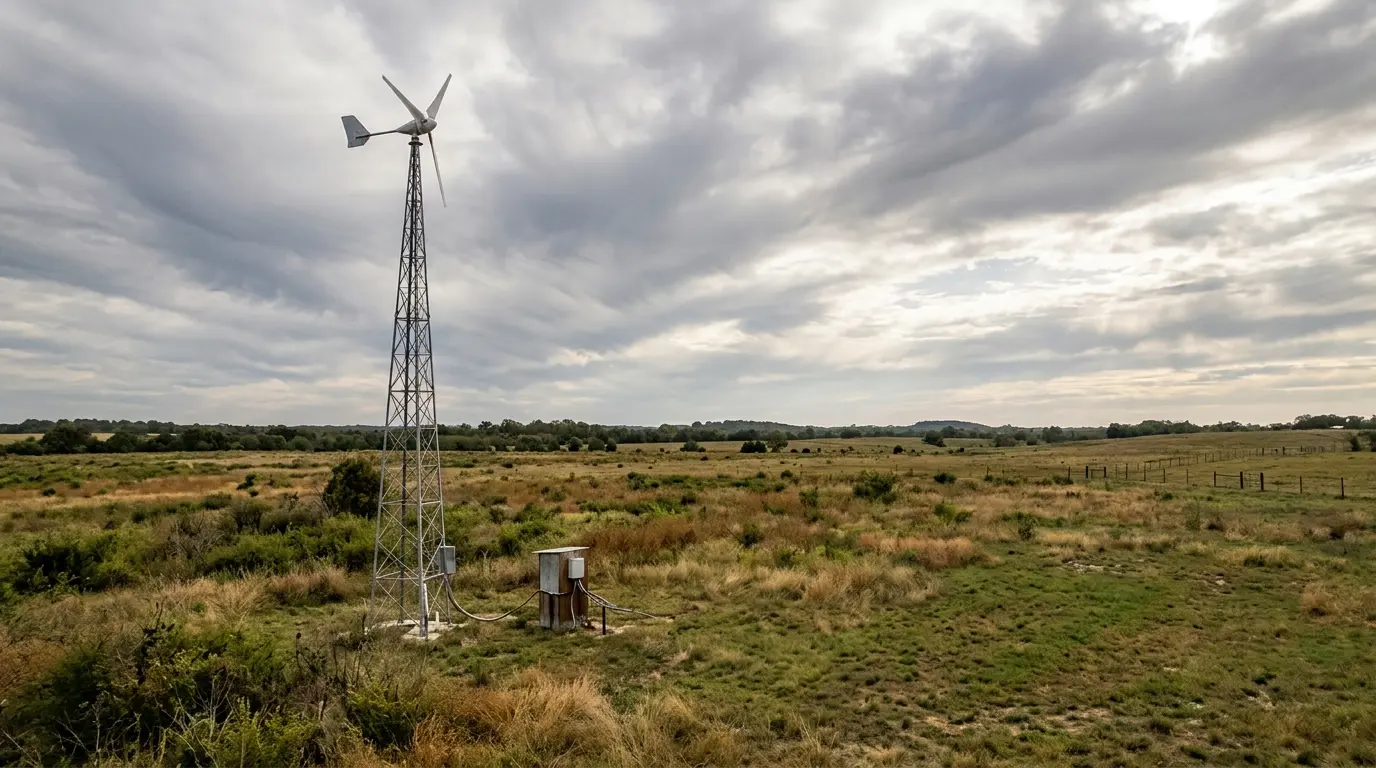
The second killer is height. Wind near the ground is slowed and shredded by every obstacle — trees, buildings, the barn itself. The industry’s rule of thumb: the turbine must sit at least 30 feet above anything within 500 feet. For most farms, that means a 100–140 ft tower — which costs more than the turbine.
And the third: a wind turbine is a machine with blades spinning at 200+ mph tip speed, in weather, forever. It has bearings, a yaw mechanism, a brake. Solar panels have no moving parts and a 25-year warranty. The maintenance profiles are not comparable; they are not even the same sport.
The Numbers, Head to Head
Scenario: farm wanting ~10,000 kWh/year of generation, Midwest location with “average-feeling” wind (11 mph at 33 ft — typical).
| Criteria | Small wind (10 kW rated) |
Solar (7 kW array) |
|---|---|---|
| Installed cost | 50,000–80,000 (turbine + 100 ft tower + install) | 15,000–19,000 |
| Realistic capacity factor | 8–15% | 15–20% |
| Annual production | 7,000–13,000 kWh (if sited perfectly) | 10,000–12,000 kWh |
| Cost per kWh over 20 years | 0.25–0.45 | 0.06–0.09 |
| Moving parts | All of them | None |
| Maintenance | Annual inspections, bearing/blade service | Hose it off 2–4×/year |
| ITC eligible | Yes (30%) | Yes (30%) |
The devastating row is the capacity factor. A “10 kW” turbine on a typical farm site produces like a 1–1.5 kW machine, because rated output assumes 24–28 mph winds that occur almost never. Solar’s rating is honest: a 7 kW array in the Midwest produces within 10% of prediction, every year, guaranteed by satellite data going back decades.
The 33-Foot Rule and Your Actual Wind
Before any wind decision: measure. An anemometer at proposed hub height, logging for a full year (1,500–1,500–4,000 for a proper assessment), is the only honest answer to “do I have wind?” Rules of the road:
- Below 10 mph average at hub height: forget it. That covers most farms east of the Plains and anything sheltered.
- 12+ mph average at hub height: wind enters the conversation. That means open plains, ridge tops, or lakeshores — and a tall tower.
- Every obstacle within 500 ft costs you. The 33-foot rule is not a suggestion; turbulence below it destroys both output and equipment life.
The Three Situations Where Wind Wins
1. Exposed ridge, plains, or lakeshore sites with measured 12+ mph winds. Real wind resources exist — western Kansas, the Dakotas, coastal ridges. On those sites, a properly towered turbine produces at a cost that competes with solar, especially in winter.
2. The winter gap. Wind resource is anti-correlated with sun: stormy winter months that starve solar arrays are exactly when turbines run hardest. For off-grid farms in northern climates, a hybrid solar + small wind system can cut required battery and generator capacity meaningfully — wind as a winter supplement, not a primary source.
3. Sites where solar can’t go. Heavy shading that can’t be cleared, heritage or land constraints against arrays, or rooftops that can’t bear load — occasionally the tower is the only generation structure a site accepts.
Note what is not on the list: “my farm feels windy.” Feel is not data. The flag snapping on the porch is at 10 ft; the turbine lives at 120.
Expert Tips
1. Never buy a turbine without a year of tower-height wind data. A seller who quotes production from a regional wind map is guessing at the one number that matters. The cube law makes small errors enormous.
2. Rooftop turbines are always a bad idea. Always. Turbulence from the building itself destroys output, and the vibration goes straight into the structure. No exceptions.
3. Budget the crane. Turbine installation and every major service requires a crane (2,000–2,000–5,000 per visit). Solar’s equivalent service call is a ladder.
4. Check zoning before falling in love. Many counties regulate tower height, setback, and noise; some prohibit small wind outright. The permit battle is part of the project cost.
5. Used turbines are usually scrap with a story. Small-wind manufacturers have a high mortality rate; orphaned turbines have no parts chain. In wind, the manufacturer’s balance sheet is a component.
6. If you have real wind, consider REAP for it too. Wind is an eligible REAP technology — the 50% cost-share changes the math on good sites the same way it does for solar.
Conclusion
The honest comparison is short: solar produces predictable kWh at 0.06–0.06–0.09 with no moving parts; small wind produces uncertain kWh at 0.25–0.25–0.45 with a machine in the sky. For nine farms in ten, solar is the answer and the turbine is a weather vane with a loan attached. For the tenth — measured 12+ mph winds, tall tower, winter-gap or hybrid logic — wind earns its place. Measure first, romanticize later.
Frequently Asked Questions
Q: Is wind or solar better for a farm?
A: Solar, for roughly nine out of ten farms. A solar array costs 2.10–2.10–2.80 per watt installed, produces within 10% of prediction annually, has no moving parts, and carries 25-year warranties. Small wind needs measured average winds above 12 mph at hub height (typically a 100–140 ft tower costing more than the turbine) to compete — most farm sites measure well below that. Wind wins on exposed ridges and plains, as a winter supplement to solar, or where arrays physically can’t go.
Q: How much does a small farm wind turbine cost?
A: A 10 kW turbine with a proper 100 ft tower runs 50,000–50,000–80,000 installed, versus 15,000–15,000–19,000 for a solar array producing the same annual energy on an average site. Operating costs diverge further: turbines need annual inspections, bearing and blade service, and crane visits at 2,000–2,000–5,000 each, while solar maintenance is a garden hose. Per kWh over 20 years, small wind typically costs 0.25–0.25–0.45 versus solar’s 0.06–0.06–0.09.
Q: Can wind and solar work together on a farm?
A: Yes, and it’s wind’s best use case: the resources are anti-correlated, with wind strongest in the stormy winter months that starve solar. For off-grid farms in northern climates, adding a properly sited small turbine to a solar + battery system can cut required battery and generator capacity significantly. The prerequisite is the same as always — a year of measured hub-height wind data proving 12+ mph averages before a dollar is spent.
Related Articles
- How to Calculate Your Farm Solar ROI Before Spending a Dollar — Run the same 6-step math on any wind quote and watch the answer.
- Generator + Solar Hybrid Systems: The Right Way to Combine Backup Power — The more practical way to cover solar’s winter gap on most farms.
- Winter Solar Production: What to Expect Month by Month (And What’s a Fault) — The seasonal gap that wind proponents promise to fill.
© 2026 Farm Solar Guide. All data sourced from NREL wind resource data, AWEA small wind reports, manufacturer specifications, and documented US farm operations. Last verified: November 23, 2026