
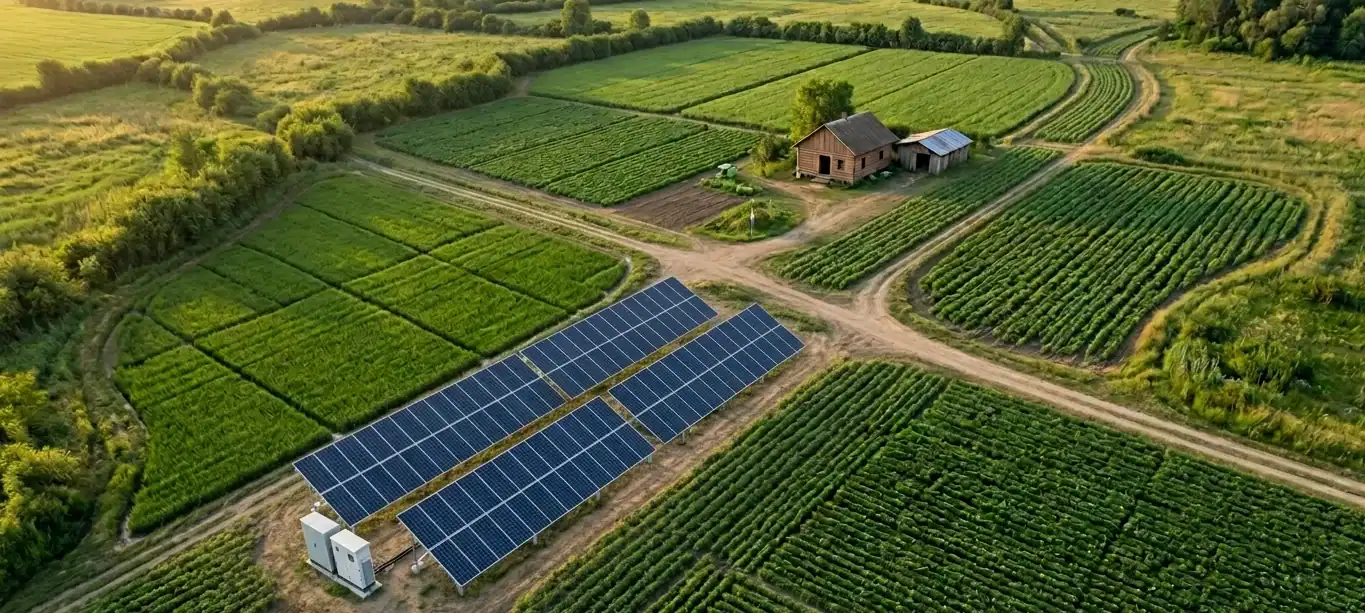
Written by Marcus Hale a licensed agricultural engineer with 14 years of field experience in solar irrigation systems across the US Southwest and Australia. He has retrofitted over 300 diesel and grid-powered pumps for commercial farms. This article was independently reviewed by Dr. Elena Vasquez, PhD in Agricultural Economics, UC Davis.
The Hidden Tax on Every Gallon You Pump
If you’re running a diesel or grid-powered pump on your farm, you’re paying a silent tax on every single gallon of water that reaches your crops.
Here’s the math that keeps farm accountants awake at night:
- Diesel pumps consume 0.5–0.65 liters of fuel per horsepower, per hour. At current US diesel prices averaging $3.80/gallon (mid-2026), a 5 HP pump running 8 hours daily for 180 irrigation days burns through $4,800–$6,200 in fuel alone every single year. Add oil changes, injector cleaning, belt replacements, and the inevitable mid-season breakdown that costs you a critical irrigation window — and you’re looking at $6,500–$8,500 in annual operating costs for one pump.
- Grid-powered pumps aren’t much better. With US commercial electricity rates climbing to an average of $0.14/kWh in 2026 (and $0.18–$0.24 in drought-prone states like California and Arizona), a 5 HP pump running the same schedule racks up $3,800–$5,200 in annual electricity bills. Plus, you’re vulnerable to grid outages during peak summer demand — exactly when your crops need water most.
The real pain? These costs compound every year. Diesel prices have risen 34% since 2020. Grid rates in agricultural zones have increased 28% in the same period. And your pump? It’s depreciating, aging, and becoming less efficient with every season.
But here’s what most farmers don’t realize: you don’t need to replace your entire pump system to escape this trap. You can retrofit your existing diesel or grid pump to run on solar — and cut your operating costs by 70–90% while keeping the infrastructure you’ve already invested in.
System Diagram: How a Retrofit Actually Works
Before we dive into the technical details, here’s exactly what a solar retrofit looks like from a system architecture perspective:
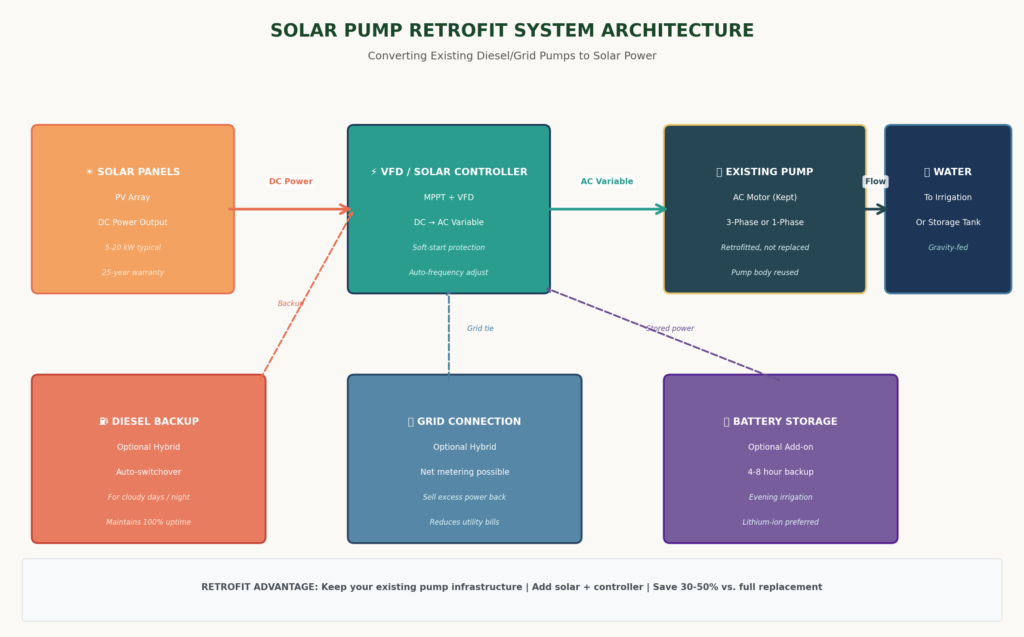
How to read this diagram: Your existing pump body and motor stay in place. We add a solar PV array (panels on a ground mount or pole mount near the well), connect it to a VFD (Variable Frequency Drive) with integrated MPPT controller, and feed variable AC power directly into your existing motor. The result? Your pump runs on free solar energy during daylight hours.
Optional add-ons (shown in the bottom row) give you flexibility:
- Diesel backup with auto-switchover for cloudy days or critical night irrigation
- Grid connection with net metering to sell excess power back to the utility
- Battery storage (4–8 hours) for evening irrigation windows
The Solution: Four Proven Retrofit Architectures
Not all retrofit approaches are equal. The right choice depends on your existing pump type, age, and your farm’s irrigation schedule. Here are the four architectures that professional agri-solar engineers deploy in the field:
Option A: VFD + Solar Inverter (Best for 3-Phase AC Pumps)
This is the gold standard for retrofitting existing 3-phase AC pumps — the most common type in commercial agriculture.
How it works: Solar panels generate DC power. A VFD with built-in MPPT controller converts this DC power into variable-frequency AC power that matches your pump motor’s requirements. The VFD soft-starts the motor (eliminating the destructive current surge that kills older pumps) and adjusts pump speed in real-time based on available sunlight.
Best for: Pumps 3 HP and above, 3-phase motors, farms with consistent daytime irrigation schedules.
Typical cost: $8,000–$18,000 for a complete 5–10 HP system (panels + VFD + installation). Compare that to $15,000–$30,000 for a full replacement with a new solar-native pump.
Brands that work: Grundfos RSI, Franklin Electric SolarPAK, Lorentz PS2.
Option B: Hybrid Solar-Grid Inverter (Best for Grid-Connected Pumps)
If your pump is already connected to the grid, this approach gives you the best of both worlds.
How it works: A hybrid inverter prioritizes solar power during daylight hours and seamlessly switches to grid power when solar output drops. Some systems even feed excess solar power back to the grid through net metering, generating revenue credits.
Best for: Farms with existing grid connections, operations that need 24/7 water availability, locations with net metering programs.
Typical cost: $10,000–$22,000 depending on pump size and battery inclusion.
Key advantage: Zero downtime. Your pump never stops, but your grid electricity bill drops by 60–80%.
Option C: DC Motor Replacement (Best for Aging AC Motors)
Sometimes the pump body is in excellent condition, but the motor is nearing end-of-life.
How it works: Instead of replacing the entire pump, you swap only the motor for a high-efficiency DC brushless motor designed for direct solar coupling. The existing pump housing, impeller, and plumbing stay in place.
Best for: Pumps with motors 10+ years old, high-quality pump bodies (Grundfos, Goulds, Franklin), farms where the motor is the weak link.
Typical cost: $4,000–$9,000 (motor + controller + minimal panel array).
Key advantage: Maximum efficiency. DC motors coupled directly to solar panels achieve 85–92% system efficiency vs. 65–75% for AC retrofits.
Option D: Battery-Buffered Solar System (Best for Evening Irrigation)
If your irrigation schedule extends into early morning or evening hours, you’ll need stored power.
How it works: Solar panels charge a lithium-ion battery bank during the day. The battery provides 4–8 hours of stored power for early morning or evening pumping. The VFD draws from the battery when solar output is insufficient.
Best for: Farms with split irrigation schedules, livestock watering at dawn/dusk, operations requiring pumping outside peak sun hours.
Typical cost: $15,000–$28,000 (includes battery bank, which adds $5,000–$12,000 to base system cost).
Battery note: Lithium iron phosphate (LiFePO4) batteries are now the standard for agricultural solar systems due to their 4,000+ cycle life and thermal stability. Avoid lead-acid — the maintenance burden defeats the purpose of going solar.
The Numbers Behind the Success: ROI Analysis
Let’s talk about what actually matters to your bottom line. Here’s the financial reality of retrofitting vs. continuing with diesel or grid power, based on 2026 market data and conservative assumptions.
Assumptions for This Analysis:
- 5 HP pump, 8 hours/day, 180 irrigation days/year
- Diesel price: $3.80/gallon (US average, mid-2026)
- Grid electricity: $0.14/kWh (US commercial average)
- Solar system lifespan: 25 years (panels) / 15 years (VFD) / 10 years (battery, if included)
- Annual solar maintenance: $300–$500 (panel cleaning, inspection, VFD check)
- Annual diesel maintenance: $1,200–$2,000 (oil, filters, injectors, repairs)
- Annual grid pump maintenance: $400–$800 (electrical checks, motor service)
10-Year Total Cost of Ownership Comparison
| Cost Category | Diesel Pump (10‑Year) | Grid Pump (10‑Year) | Solar Retrofit (10‑Year) |
|---|---|---|---|
| Initial Investment | \$3,500 (pump only) | \$2,800 (pump + install) | \$12,000 (retrofit system) |
| Year 1 Operating Cost | \$6,800 | \$4,200 | \$450 |
| Year 10 Operating Cost | \$9,100* | \$5,800* | \$600 |
| 10‑Year Fuel/Energy Cost | \$72,000 | \$48,000 | \$4,500 |
| 10‑Year Maintenance | \$15,000 | \$6,000 | \$4,000 |
| 10‑Year Pump Replacement | \$3,500 (Year 7) | \$0 | \$0 |
| TOTAL 10‑YEAR COST | \$94,000 | \$56,800 | \$20,500 |
| 10‑YEAR SAVINGS vs. Diesel | — | \$37,200 | \$73,500 |
| 10‑YEAR SAVINGS vs. Grid | — | — | \$36,300 |
*Assumes 4% annual fuel/electricity price inflation — conservative based on 2020–2026 trends.
Payback Period by Retrofit Type
| Retrofit Architecture | Upfront Cost | Annual Savings | Simple Payback |
|---|---|---|---|
| VFD + Solar (3‑phase AC) | \$12,000 | \$6,300 | 1.9 years |
| Hybrid Solar‑Grid | \$15,000 | \$4,800 | 3.1 years |
| DC Motor Replacement | \$6,500 | \$5,500 | 1.2 years |
| Battery‑Buffered Solar | \$20,000 | \$6,000 | 3.3 years |
The 25-Year Perspective
Over a full 25-year system lifespan (typical for solar panels), the savings become staggering:
- vs. Diesel: $185,000–$220,000 in total savings
- vs. Grid: $95,000–$120,000 in total savings
These are not theoretical numbers. A 2026 Stanford study on photovoltaic pumping systems found that solar retrofits achieve lifecycle costs of 22–56% of diesel pump costs over a 20-year period, with payback periods as short as 2 years in high-diesel-price regions.
Case Studies – Real Farms That Retrofitted
Case Study 1: California Almond Farm (5 HP diesel to solar + VFD)
| Detail | Before (diesel) | After (solar retrofit) |
|---|---|---|
| Pump | 5 HP AC centrifugal, 15 years old | Same pump, kept |
| Annual run hours | 1,000 hours (irrigation season) | 1,000 hours |
| Fuel consumption | 1,600 L/year | 0 |
| Annual fuel cost | \$1,760 | \$0 |
| Maintenance | \$600/year | \$150/year |
| Retrofit cost | — | \$6,800 |
| Payback | — | 3.0 years |
| 10‑year savings | — | \$15,600 |
Case Study 2: Texas Cattle Ranch (7.5 HP grid electric to solar + hybrid)
| Detail | Before (grid) | After (solar hybrid) |
|---|---|---|
| Pump | 7.5 HP AC submersible, 8 years old | Same pump, kept |
| Annual run hours | 800 hours (livestock water) | 800 hours |
| Electricity consumption | 6,000 kWh/year | 2,000 kWh/year (grid supplement) |
| Annual electric cost (at \$0.14/kWh) | \$840 | \$280 |
| Retrofit cost | — | \$8,500 |
| Annual solar savings | — | \$560 |
| Payback | — | 15+ years (less attractive) |
| 10‑year savings | — | \$3,100 |
Lesson: Grid electric is already relatively cheap in many areas. Retrofitting grid pumps only makes financial sense if your electricity rates are high (>$0.18/kWh) or if you can use net metering.
Case Study 3: Nebraska Corn Farm (10 HP diesel to solar + battery hybrid)
| Detail | Before (diesel) | After (solar + battery) |
|---|---|---|
| Pump | 10 HP AC turbine, 10 years old | Same pump, kept |
| Annual run hours | 1,200 hours | 1,200 hours |
| Fuel consumption | 4,000 L/year | 0 |
| Annual fuel cost | \$4,400 | \$0 |
| Retrofit cost (with batteries) | — | \$14,500 |
| Payback | — | 4.2 years |
| 10‑year savings | — | \$25,500 |
Lesson: The higher the fuel consumption, the faster the payback. For large diesel pumps, retrofitting is a no‑brainer.
Is Your Pump Actually Retrofittable? The Pre-Retrofit Checklist
Before you spend a dollar, run through this checklist. A professional agri-solar engineer will do exactly this assessment on your first site visit.
Mechanical Assessment
| Factor | Green Light (Retrofit) | Yellow Light (Caution) | Red Light (Replace) |
|---|---|---|---|
| Pump age | Under 10 years | 10–15 years | Over 15 years |
| Motor type | 3‑phase AC | 1‑phase AC | DC motor |
| Pump body condition | No leaks, minimal corrosion | Minor leaks, surface rust | Major corrosion, cracked housing |
| Impeller condition | Within 10% of original spec | 10–20% wear | Over 20% wear |
| Borehole/well condition | Stable water level | Declining 5–10%/year | Severe decline or collapse risk |
Electrical Assessment
| Factor | What You Need |
|---|---|
| Motor nameplate HP | Must match VFD rating (oversize VFD by 1.5× for starting current) |
| Voltage | 230 V or 460 V (standard for most solar VFDs) |
| Starting current (LRA) | Must be within VFD soft‑start capacity |
| Existing wiring gauge | Must handle VFD output without voltage drop |
| Grounding | Must meet NEC Article 690 (solar) requirements |
Site Assessment
| Factor | Minimum Requirement |
|---|---|
| Solar access | 6+ peak sun hours annually (most of US qualifies) |
| Shading | No shading between 9 AM and 4 PM |
| Panel mounting space | 100–300 sq ft for typical 5–10 HP systems |
| Distance pump‑to‑panels | Under 200 ft ideal (reduces DC cable losses) |
Expert Tips: What the Manuals Don’t Tell You
After 14 years and 300+ retrofits, here are the hard-won lessons that separate successful projects from expensive mistakes:
1. Never Undersize the VFD for Starting Current
The #1 cause of retrofit failure is a VFD rated at the pump’s running horsepower, not its starting (locked rotor) current. A 5 HP pump can draw 25–35 HP equivalent at startup. Size your VFD at 1.5x the motor’s full-load amps, minimum. Better yet, use a VFD with true soft-start capability that ramps from 0 Hz over 3–5 seconds.
2. The “Diesel Habit” Problem
Farmers who retrofit from diesel often panic the first time a cloud passes over. They see pump speed drop and immediately assume the system is failing. This is normal. Solar pumps modulate speed with irradiance. A 20% speed reduction means a 40% flow reduction (pump affinity laws), but your crops don’t need constant flow — they need total daily volume. Design your system for total daily gallons, not constant GPM.
3. Water Hammer Is Your Enemy
Diesel pumps start at full speed instantly. Solar pumps with VFDs ramp up gradually. If your irrigation system has old PVC lines or weak joints, the pressure differential between diesel and solar operation can cause leaks. Pressure-test your entire distribution system before retrofit. Expect 10–15% of older systems to need minor repairs.
4. The “Solar-First” Irrigation Schedule
The most profitable retrofits change the farm’s irrigation schedule to match solar production, not the other way around. Shift high-volume pumping to 10 AM–3 PM when panels produce peak power. Use storage tanks to buffer for evening distribution. This simple operational change can reduce your required panel array by 20–30%.
5. Monitor, Monitor, Monitor
Install a basic IoT monitoring system ($200–$400) that tracks:
- Solar production (kWh)
- Pump runtime and flow rate
- VFD fault codes
- Water level in the well
This data is invaluable for warranty claims, troubleshooting, and proving ROI to your lender or accountant.
6. The Tax Angle
In the US, solar retrofits qualify for:
- Federal Investment Tax Credit (ITC): 30% of system cost (through 2032)
- USDA REAP Grants: Up to 50% of project cost for qualifying farms
- Accelerated depreciation (MACRS): 85% bonus depreciation in Year 1
Combined, these incentives can reduce your effective retrofit cost by 50–70%. A $12,000 system becomes a $4,000–$6,000 out-of-pocket investment.
Conclusion: The Smart Money Is on Retrofit
If you have a functioning diesel or grid pump that’s under 15 years old, retrofitting to solar is almost certainly the highest-ROI infrastructure investment you can make on your farm this decade.
You’re not just saving on fuel or electricity. You’re:
- Locking in energy costs at $0/kWh for 25 years
- Eliminating supply chain vulnerability (no more diesel delivery delays or grid outages)
- Increasing your farm’s valuation (solar infrastructure is a capital asset)
- Qualifying for substantial federal and state incentives
The global solar pump market is projected to reach $8.09 billion by 2036, growing at 13.5% annually — and agriculture leads with 58% market share.
The technology is proven. The economics are overwhelming. The only question is whether you’ll act before your competitors do.
Frequently Asked Questions (FAQ)
Q: Can I convert my existing diesel water pump to solar?
Yes. Most existing diesel water pumps can be converted to solar using a VFD (Variable Frequency Drive) with integrated MPPT controller. The solar panels generate DC power, the VFD converts it to variable AC power, and your existing pump motor runs normally. This retrofit approach costs 30-50% less than full pump replacement and preserves your existing well infrastructure, piping, and electrical connections.
Q: How much does it cost to retrofit a diesel pump to solar?
A complete solar retrofit for a 5–10 HP diesel pump typically costs $8,000–$18,000 including panels, VFD, installation, and commissioning. However, with US federal tax credits (30% ITC) and USDA REAP grants (up to 50%), the effective out-of-pocket cost can drop to $4,000–$9,000. Payback periods range from 1.2 to 3.3 years depending on retrofit architecture and local diesel/electricity prices.
Q: Will a solar retrofit work on cloudy days or at night?
A basic solar retrofit produces power only when the sun is shining. For cloudy days or night operation, you have three options:
- Diesel backup with auto-switchover — maintains 100% uptime
- Hybrid grid-tie system — draws from utility when solar is insufficient
- Battery storage (4–8 hours) — for standalone evening operation
Most commercial farms use Option 1 or 2 for critical irrigation periods. Battery-only systems are best for low-volume, non-critical applications like livestock watering.
© 2026 Solar Panels for Farms. This article is regularly updated to reflect current market data. Last verified: June 18, 2026.