
Written by Dr. Robert Kowalski a Ph.D. in Agricultural and Biological Engineering from Penn State University and has 18 years of experience in on-farm electrical systems and energy storage. He has designed battery-backed solar systems for irrigation, dairy, poultry, and cold storage operations across the Midwest and Northeast. He is a licensed Professional Engineer and a member of the American Society of Agricultural and Biological Engineers.
The Problem
Battery storage has moved from optional to essential on many farms. Reduced export compensation means that electricity you cannot use on-site is worth far less than it used to be, which makes storing and shifting production economically valuable for the first time. Add the reliability case — irrigation that cannot stop, ventilation that cannot fail, milk that cannot warm — and batteries are now a mainstream farm investment.
The problem is that most farm battery systems are sized incorrectly, and the errors run in both directions.
Some systems are dramatically oversized. A farmer is sold a large battery bank “for energy independence,” when the actual load profile only requires a few hours of load shifting. The extra capacity sits unused, degrading slowly, representing capital that will never pay back.
Other systems are dramatically undersized. A battery is selected for its kilowatt-hour rating while ignoring its power rating, and the system cannot deliver the surge current required to start a pump motor. Or a system is sized for summer operation and fails in winter, when cold temperatures reduce usable capacity and heating loads increase.
The consequence is consistent: money spent, performance not delivered. The average cost of a mis-sized farm battery system — measured as capital wasted plus capacity that must be added later — runs around $18,000 in the cases I have reviewed.
This guide replaces guesswork with a method.
The Solution: The Four-Step Sizing Method
Battery sizing is not a single calculation. It is a sequence of four decisions, and each one constrains the next.
Step 1 — Define the actual job the battery must do.
There are four distinct jobs a farm battery can perform, and they require different sizes:
- Peak shaving. Discharge during short high-demand windows to reduce demand charges or avoid peak-rate purchases. Typically requires 1 to 3 hours of discharge.
- Load shifting. Store midday solar production and discharge it in the evening. Typically requires 4 to 8 hours of discharge.
- Backup power. Carry critical loads through an outage. Duration depends on what you define as critical — a few hours for ventilation, potentially a full day for milking and cooling.
- Off-grid operation. Carry the entire load indefinitely with solar recharge. Requires the largest capacity and the most careful design.
Most farms need one or two of these jobs, not all four. Defining the job first prevents the most common error: buying for the largest possible job when you only need the smallest.
- Step 2 — Build the load profile, in kilowatts and in hours.
You need two numbers for every load the battery will serve: how much power it draws (kW) and how long it runs (hours). Multiplying gives kilowatt-hours (kWh). But the power number matters independently, because it determines whether the battery can actually run the load.
| Load | Power (kW) | Hours/Day | Energy (kWh/Day) |
|---|---|---|---|
| 50 HP pivot irrigation pump | 37 | 8 | 296 |
| Dairy parlor (milking, vacuum, cooling) | 25 | 12 | 300 |
| Poultry house ventilation (20,000 birds) | 8 | 14 | 112 |
| Cold storage compressor | 12 | 10 | 120 |
| Farm shop (intermittent tools) | 15 (peak) | 3 | 45 |
| Total | — | — | 873 kWh/day |
Step 3 — Apply depth of discharge and round-trip efficiency.
A battery’s nameplate capacity is not its usable capacity. Depth of discharge (DoD) is the percentage of capacity you actually cycle. Round-trip efficiency is the percentage of energy you get back out compared to what you put in.
Usable capacity = Nameplate capacity × DoD × Round-trip efficiency
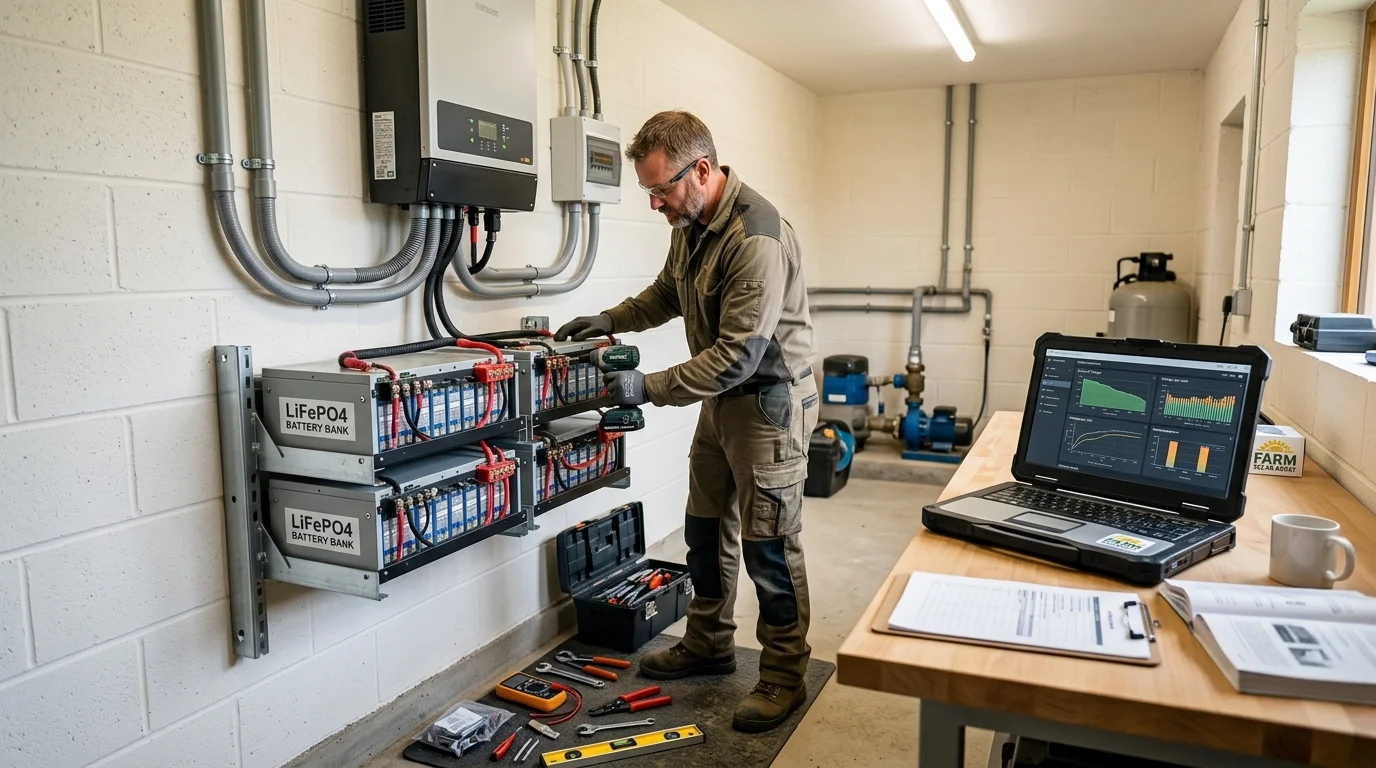
Lithium iron phosphate (LiFePO4) batteries, the current standard for farm installations, typically allow 80% to 90% DoD and achieve 90% to 95% round-trip efficiency. Older lead-acid batteries allow only 50% DoD and about 80% efficiency — which is why replacing lead-acid with lithium often means the same usable capacity in less than half the nameplate size.
Step 4 — Check the C-rate against your surge loads.
This is the step most sizing exercises skip, and it is the one that causes the most failures.
C-rate describes how fast a battery can discharge relative to its capacity. A 1C battery can discharge its full capacity in one hour. A 0.5C battery takes two hours. A 0.2C battery takes five hours.
Motor starting is the problem. A pump motor that draws 37 kW running may draw 110 kW or more for a second or two at startup. If the battery’s power rating cannot deliver that surge, the system either fails to start the motor or trips offline.
Rule of thumb: size the battery’s continuous power rating at least 1.5 times the largest motor’s running load, and verify the battery’s surge rating covers the motor’s locked-rotor current. If it does not, you need either a larger battery or a soft-start device on the motor.
The Numbers Behind the Success: Three Worked Examples
Example A — 50 HP Pivot Irrigation Pump
| Parameter | Value |
|---|---|
| Motor running load | 37 kW |
| Daily run time | 8 hours |
| Daily energy required | 296 kWh |
| Job required | Load shifting (midday solar → evening/night irrigation) |
| Required usable capacity | 296 kWh (full daily load) |
| LiFePO₄ DoD | 85% |
| Round‑trip efficiency | 92% |
| Required nameplate capacity | 296 ÷ (0.85 × 0.92) = 379 kWh |
| Continuous power requirement | 37 kW × 1.5 = 55.5 kW |
| Battery cost estimate (2026, installed) | $450 – $600 per kWh nameplate |
| Estimated installed cost | $170,000 – $227,000 |
Example B — Dairy Parlor
| Parameter | Value |
|---|---|
| Running load | 25 kW |
| Daily run time | 12 hours |
| Daily energy required | 300 kWh |
| Job required | Backup power for milking and cooling (critical) |
| Required usable capacity | 300 kWh (12 hours critical autonomy) |
| LiFePO₄ DoD | 85% |
| Round‑trip efficiency | 92% |
| Required nameplate capacity | 300 ÷ (0.85 × 0.92) = 384 kWh |
| Continuous power requirement | 25 kW × 1.5 = 37.5 kW |
| Battery cost estimate (2026, installed) | $450 – $600 per kWh |
| Estimated installed cost | $173,000 – $230,000 |
Example C — Poultry House Ventilation (20,000 Birds)
| Parameter | Value |
|---|---|
| Running load | 8 kW |
| Daily run time | 14 hours |
| Daily energy required | 112 kWh |
| Job required | Backup for ventilation during heat events (critical, short duration) |
| Required usable capacity | 56 kWh (7 hours critical autonomy) |
| LiFePO₄ DoD | 85% |
| Round‑trip efficiency | 92% |
| Required nameplate capacity | 56 ÷ (0.85 × 0.92) = 72 kWh |
| Continuous power requirement | 8 kW × 1.5 = 12 kW |
| Battery cost estimate (2026, installed) | $500 – $650 per kWh |
| Estimated installed cost | $36,000 – $47,000 |
Summary comparison:
| Application | Job | Nameplate Capacity | Estimated Installed Cost |
|---|---|---|---|
| 50 HP pivot pump | Load shifting | 379 kWh | $170,000 – $227,000 |
| Dairy parlor | Backup (12 hr critical) | 384 kWh | $173,000 – $230,000 |
| Poultry ventilation | Backup (7 hr critical) | 72 kWh | $36,000 – $47,000 |
Payback note: Battery payback depends entirely on the value of what it displaces. For the pivot pump under avoided-cost export rules, each stored kilowatt-hour avoids a $0.12 purchase instead of earning $0.04 — a swing of $0.08 per cycle. At one cycle per day, 300 days per year, that is $24 per kWh of usable capacity per year. A 379 kWh system cycling daily therefore captures roughly $9,100 per year in value, giving a simple payback of approximately 19 to 25 years on battery cost alone. This is why battery storage is usually justified for backup and reliability first, and for energy arbitrage second.
Expert Tips
1. C-rate kills more farm batteries than cycling does. A battery cycled gently at 0.2C will often outlast a battery cycled at 1C, even though the manufacturer’s cycle life rating may be identical. If your load profile involves frequent high-power surges — pump starts, compressor starts, motor starts — specify a battery with a higher continuous power rating, or add soft-start devices. The extra cost is almost always less than premature replacement.
2. Cold temperature reduces usable capacity, not just efficiency. At 32°F, LiFePO4 capacity drops modestly; at 0°F, the reduction is significant, and charging below freezing can damage the cells. If your battery is in an unconditioned space, either insulate and heat the enclosure or specify a battery with an integrated heater. Size for winter, not summer.
3. Do not size to your average load — size to your critical load. The question for backup sizing is not “what do I use on average?” It is “what absolutely cannot stop, and for how long?” A poultry house needs ventilation for bird survival. A dairy needs milking and cooling for milk quality. A farm shop does not need anything. Separating critical from non-critical loads can cut required battery capacity by 60% or more.
4. Lithium iron phosphate is the default chemistry in 2026 — but verify the BMS. LiFePO4 offers longer cycle life, higher DoD, better efficiency, and no maintenance compared to lead-acid. The battery management system (BMS) is what actually enforces safe operation. Confirm the BMS includes low-temperature charge protection, cell balancing, and communication with your inverter. A good battery with a poor BMS is a warranty claim waiting to happen.
5. Design for replacement at year 12 to 15, not year 25. Most LiFePO4 warranties cover 10 to 15 years or a specified throughput in megawatt-hours, whichever comes first. Your 25-year cash flow model should include a battery replacement reserve. If your financial analysis only works because it assumes the original battery lasts the full 25 years, the analysis is wrong.
6. If you are adding storage to an existing system, check inverter compatibility first. Not all inverters support battery addition, and not all batteries communicate with all inverters. Confirm both the electrical compatibility and the communication protocol before purchasing. This single check prevents the most expensive mistake in retrofit projects.
Conclusion
Battery sizing on a farm comes down to four decisions made in the right order: define the job, build the load profile, apply depth of discharge and efficiency, and verify the C-rate against your surge loads.
The most common error is buying for a job you do not have — paying for off-grid capability when you need peak shaving, or sizing for average load when the real requirement is critical load. The second most common error is ignoring C-rate and discovering at commissioning that the battery cannot start your largest motor.
The financial case for farm batteries has strengthened in 2026, not because batteries got dramatically cheaper, but because export compensation got worse. When exported electricity is worth $0.04 and self-consumed electricity avoids $0.12, storing production has real value. But for most farms, the reliability case — irrigation that does not stop, ventilation that does not fail, milk that does not warm — is the stronger justification.
Size for the job you actually have, and the payback will take care of itself.
Frequently Asked Questions
Q: How big of a battery do I need for my farm solar system?
A: It depends on what job the battery must do. For load shifting, you need usable capacity equal to the energy you want to shift — typically the daily energy of the loads you want to run in the evening. For backup, you need usable capacity equal to your critical loads multiplied by your required autonomy hours. Add a 15% to 20% margin for depth of discharge and round-trip efficiency losses, and verify the battery’s power rating can handle your largest motor’s surge current. Most farm systems fall between 50 kWh and 400 kWh of nameplate capacity.
Q: Can I run a farm off-grid with batteries?
A: It is possible but expensive, and it is rarely the right choice for a working farm. Off-grid operation requires enough battery capacity to carry the entire load through multiple cloudy days, plus a solar array large enough to recharge it, plus a backup generator for extended low-sun periods. The result is typically three to five times the cost of a grid-tied system with battery backup. Most farms are better served by a grid-tied system with a battery sized for critical loads, keeping the grid as the ultimate backup.
Q: How long will a farm battery bank last?
A: Lithium iron phosphate batteries typically carry warranties of 10 to 15 years or a specified throughput in megawatt-hours. Real-world life depends on depth of discharge, cycle frequency, temperature, and C-rate. A gently cycled battery in a temperature-controlled space may exceed its warranty period; a heavily cycled battery in a cold enclosure may not reach it. For financial modeling, assume replacement at year 12 to 15 and include a reserve in your cash flow analysis rather than assuming the original battery lasts the full 25-year system life.
Related Articles
- How Long Does a Solar Battery Last in a Barn? (Real Numbers) — Cycle life, temperature effects, and replacement timing.
- How to Size a Solar System for Your Farm Shop and Power Tools — Load profile building for intermittent and surge loads.
- How to Replace Your Solar Charge Controller: MPPT vs PWM Upgrade Guide — Component compatibility when adding storage.
© 2026 Farm Solar Guide. All data sourced from ASAE water system standards, manufacturer cold-temperature specifications, EIA fuel price projections, and documented US farm operations. Last verified: October 6, 2026