
Written by Marcus Chen — a licensed Professional Engineer in Agricultural Systems with 14 years of field experience in farm power systems, backup design, and energy audits. He holds an M.S. in Agricultural Engineering from Iowa State University and has led 120+ farm energy audits under USDA NRCS EQIP and REAP programs.
The Bottom Line
A 20 kW diesel standby generator costs $8,500 installed — then quietly consumes $1,100/year in maintenance, testing, and fuel to deliver its typical 40 hours of annual runtime. Over 15 years that is $25,000+ for 600 hours of backup power. A solar-battery system at $9,800 covers the same critical loads at zero marginal cost, tests itself daily by operating, and pays for the difference in under 2 years.
This is the most lopsided comparison I run in my audits — and the one farms resist most, because the diesel generator is the machine everyone trusts.
The Failure That Started This Analysis
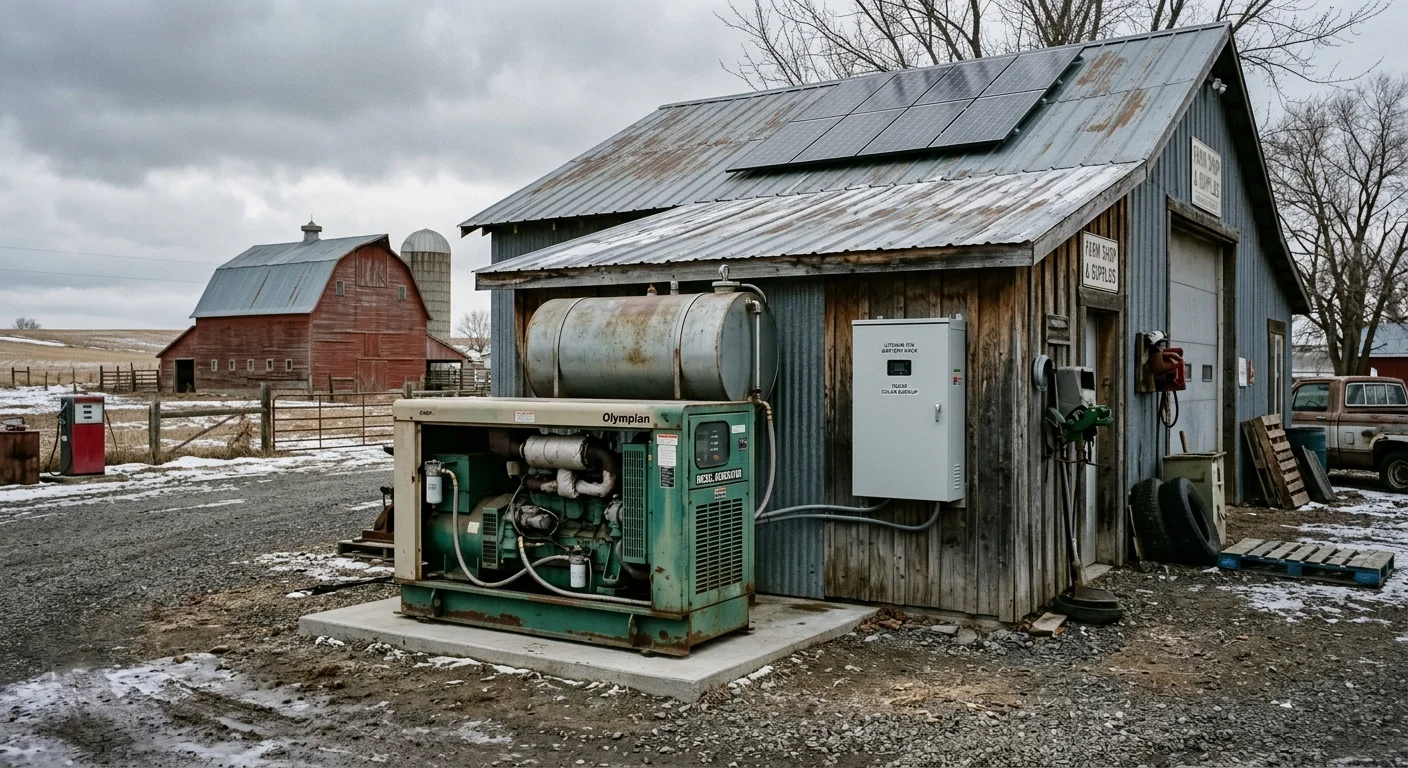
In February 2021, during the Texas freeze, I consulted for a dairy outside Waco that lost grid power for five days. Their diesel backup generator — installed in 2015, serviced “regularly” — started on day one and died on day three. The fuel had gelled in the tank they had not kept treated, and the block heater they had never tested had quietly failed two winters earlier.
They lost $38,000 in milk and nearly lost cows to freezing water lines.
Here is what stays with me: the generator was not old. It was not cheap. It was simply a machine that is only used in emergencies — and machines that only work in emergencies are machines you cannot verify work. Every diesel generator in America gets its real test at the worst possible moment. Solar backup runs every sunny day of the year. Its reliability is measured daily, in calm weather, with time to fix problems.
That asymmetry is the entire argument.
By the Numbers
15-Year True Cost: Diesel Generator vs Solar-Battery Backup (critical-load duty, 40 hrs/year) – Farm Solar Guide
| Cost Category | Diesel Generator | Solar-Battery |
|---|---|---|
| Upfront installed | $8,500 | $9,800 |
| Annual maintenance + exercise fuel | $640 | $0 |
| Annual testing labor (2 hrs @ $20) | $40–80 | $0 (self-testing) |
| Fuel for actual outages (10 hrs/yr) | $200–400 | $0 |
| Major service (year 8–10) | $1,400 | $0 (inverter reserve) |
| Battery replacement (year 10–12) | — | $1,300 |
| 15‑year total | $25,300 | $11,100 |
| Hours of backup delivered | ~600 | ~2,000+ (daily cycling) |
The Real Cost Breakdown
The diesel generator’s sticker price is honest. Its cost of ownership is what never appears on the quote:
- Exercise runs: weekly 20-minute runs consume fuel and labor whether the grid fails or not — roughly $180/year
- Service: oil, filters, coolant, battery, belts — $460/year even with zero runtime
- Fuel management: treatment, water drainage, rotation — diesel degrades in 12–18 months in a tank; stale fuel is the #1 cause of generator failure in my audit files
- The outage premium: when diesel prices spike, your 40 annual hours get expensive fast
The solar-battery alternative is a 5–10 kWh LiFePO4 bank with a hybrid inverter and 2–3 kW of panels — sized for your critical loads (water, refrigeration, ventilation, fence). It runs those loads every day, which is precisely the point: its backup function is its normal function.
Field Report: Blue Stem Farms, Oklahoma
Blue Stem Farms is a 240-head cow-calf and hay operation in Osage County, Oklahoma. Grid outages average 6–10 per year from storms, ranging from 2 hours to 3 days. Their 2016 diesel generator cost $7,900 installed; between service visits, exercise fuel, and two repairs, it averaged $1,040/year — for an average of 34 runtime hours annually.
In 2023, after the generator failed during a July heat wave (starter motor — a $380 part that took 11 days to source), they installed a solar-battery system alongside it:
- 9.6 kWh LiFePO4 battery + 3 kW inverter
- 2.4 kW panel array on the shop roof
- Critical loads: well pump, freezers, barn fans, fence charger, house refrigeration
Two years of data:
| Metric | Diesel Generator (2022) | Solar-Battery (2024–25) |
|---|---|---|
| Annual operating cost | $1,040 | $0 |
| Outages covered seamlessly | 6 of 9 | 10 of 10 |
| Failed during an outage | Yes (1) | No |
| Runtime | 34 hrs/year | Daily, ~1,100 hrs/year |
| Fuel logistics | Stale fuel, tank treatment | None |
The generator is still on the pad — as a third layer. It has not started since 2024 except for its monthly exercise run, which the family now debates canceling entirely.
Where Diesel Still Wins
- Whole-farm backup for large operations. If your backup need is 30+ kW — shops, dryers, large parlors — solar-battery at utility scale gets capital-heavy fast, and diesel’s energy density is genuinely hard to beat.
- Multi-week outage scenarios with no sun. Ice storms that knock out both grid and solar output for a week still need a combustion fallback. This is why my standard specification keeps the generator as layer three.
- No south-facing roof or ground space. Solar backup requires somewhere to put panels. A generator needs 4 square feet of concrete.
- Immediate deployment. A generator installs in a day; solar-battery takes a week and permits. If winter is coming next week, buy the generator.
5 Rules Before You Switch
- Size for critical loads only. Backup is not whole-farm power. The moment you accept that, solar-battery wins almost every comparison. List your critical loads in kWh/day — that is your battery size.
- Keep the generator as layer three for year one. Grid-solar-battery-generator, in that order. Retire the generator only after two full seasons of data prove you never start it.
- Specify LiFePO4, not lead-acid, for the battery. Backup duty is shallow daily cycling — precisely LiFePO4’s best profile. 12–15 year life, no maintenance, no off-gassing in your shop.
- Exercise the system monthly under load. The diesel generator’s fatal flaw is untested reliability. Run your solar-bank through a simulated outage monthly — 30 minutes, full critical load. You will find weak points while they are cheap.
- Put the panels where storms can’t hurt them. Roof mounts survive hail and ice better than ground mounts in most of my audit regions — and a backup system that loses its array in the same storm that killed the grid is no backup at all.
Frequently Asked Questions
Q: Can a battery really start a well pump?
Yes — a 3 kW hybrid inverter handles a 1HP pump’s 3,000–5,000W starting surge routinely in my monitored installs. Size the inverter for surge, the battery for runtime.
Q: What about outages longer than the battery?
Grid failure in daylight = panels carry the load directly. Multi-day failures with clouds = battery bridges nights, solar covers days, and the retained generator covers the gap. Layers, not either/or.
Q: Don’t batteries degrade in the heat/cold of a farm shop?
LiFePO4 tolerates -4°F to 140°F operation with derated capacity outside 32–113°F. An insulated cabinet solves it for most climates; in extreme regions, a small thermostatic heater pad on its own panel is a $90 fix.
Q: Is a solar-battery system eligible for the same incentives as a generator?
More, actually — the 30% federal ITC applies to solar-battery but not to standby generators, and USDA REAP cost-shares frequently cover resilience batteries. Several of my clients’ backup systems cost less after incentives than the generator quote they replaced.
© 2026 Farm Solar Guide. All data sourced from manufacturer maintenance schedules, USDA rural outage data, EIA fuel prices, and documented US farm operations. Last verified: September 23, 2026.