
Written by Marcus Chen — a licensed Professional Engineer in Agricultural Systems with 14 years of field experience in livestock housing, ventilation, and farm energy systems. He holds an M.S. in Agricultural Engineering from Iowa State University and has led 120+ farm energy audits under USDA NRCS EQIP and REAP programs, including 20+ poultry operations.
The Bottom Line
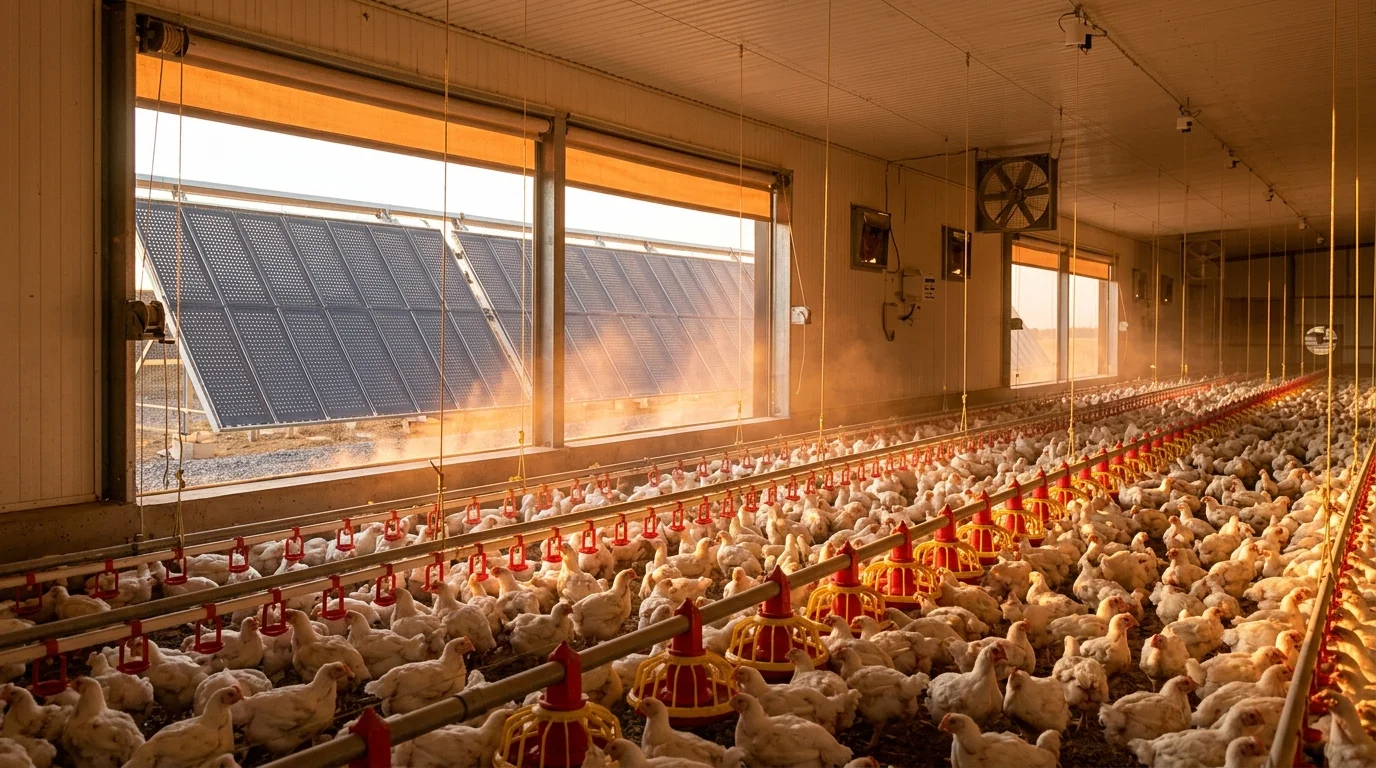
A 40×500 ft broiler barn in a Northern winter needs roughly 1.1 million BTU/hour to hold 85–90°F for day-old chicks. Delivered by fuel oil at $3.40/gallon, that is $28,000–30,000 per winter. A transpired solar air heating wall — the dark perforated metal panel system mounted on the barn’s south side — displaces 55–65% of that load for $18,000–24,000 installed, paying back in about 1.5 winters.
Of all the solar technologies I specify, this one has the fastest payback in livestock housing. It is not close.
Why Broiler Heat Is the Perfect Solar Application
Most farmers — and frankly, most engineers — think of solar as a warm-weather technology. Broiler heating is the exception that proves the rule, for three reasons:
1. The heat demand peak aligns with the solar season. Brooding happens November through March. Yes, those are short days — but they are also cold, dry, high-pressure days, which produce excellent solar irradiance per daylight hour. A transpired collector at 0°F ambient with full sun can still deliver air at 60–80°F.
2. The required temperature is low. You are not making 160°F water; you are pre-heating ventilation air from 10°F to 45°F. Low-temperature heat is exactly what solar does cheapest. Every degree of pre-heat is a degree your oil burner does not pay for.
3. The fuel alternative is expensive. Propane and fuel oil both carry rural delivery premiums and price volatility. A client of mine saw his delivered fuel oil price move from $2.60 to $4.10/gallon in a single season. Solar heat has no delivery truck.
By the Numbers
Fuel Oil vs Solar Air Heat (40×500 barn, Dec–Mar) – Farm Solar Guide
| Metric | Fuel Oil Only | Solar + Fuel Oil |
|---|---|---|
| Winter fuel use | 8,200 gal | 3,100 gal |
| Winter fuel cost | $27,900 | $10,500 |
| Installed heat system | $9,000 (furnace) | $9,000 + $21,000 (solar wall) |
| Payback on solar wall | — | 1.5 winters |
| 10‑year fuel total | $279,000 | $105,000 |
10-year fuel savings: $174,000 on a $21,000 investment.
The Real Cost Breakdown
Transpired solar collectors are deceptively simple. A dark, perforated metal skin covers the south wall. The barn’s negative-pressure ventilation draws outside air through thousands of tiny perforations; the air picks up 30–70°F of free heat in a 1-inch boundary layer before it ever enters the building. No glazing, no fluid, no heat exchanger — the barn fan is the pump.
- Collector wall (2,000–2,400 sq ft @ ~$8/sq ft installed): $16,000–19,000
- Ducting + 2 × 24V DC circulation fans: $2,800
- Differential thermostat + motorized damper controls: $1,400
- Mounting, flashing, hardware: $800
- Total: $21,000–24,000
The circulation fans run on a small dedicated solar array — which means the system heats even during a grid outage, when fuel oil furnaces sit dead without electricity. In a sector where a 4-hour January blackout can kill a flock, heat that works when the grid fails is worth more than the fuel savings alone.
Field Report: Cedar Run Poultry, Pennsylvania
Cedar Run Poultry raises 115,000 broilers per cycle across four 40×500 barns in Lancaster County. Their 2024–25 winter fuel oil bill hit $112,000 for all four barns — their highest ever, driven by a $0.80/gallon price increase on top of a cold December.
In June 2025, they retrofitted one barn with a transpired solar collector as a monitored test before committing the capital:
- 2,400 sq ft collector on the south gable end wall
- 2 × 300W panels powering the DC circulation fans — fully independent of the barn grid
- Existing 85,000 BTU oil furnace retained as backup and brooding-peak unit
Results, December 2025 – February 2026 (the monitored test winter):
| Metric | 3 Oil-Only Barns (avg) | Solar Test Barn |
|---|---|---|
| Fuel oil used | 8,400 gal | 3,250 gal |
| Fuel cost | $28,600 | $11,050 |
| Furnace runtime | 68% of winter hours | 29% of winter hours |
| Air quality (NH₃ avg) | 22 ppm | 18 ppm |
| Savings | — | $17,550/winter |
Note the air quality line — a bonus we did not promise. Pre-heated fresh air means drier litter, which means lower ammonia. Payback on the $21,000 retrofit: 1.2 winters. Cedar Run is now collecting bids for the remaining three barns, and the integrator that buys their birds has asked for my contact details for their other growers.
Where Fuel Oil Still Wins
Honesty matters here, because a bad solar installation on a poultry barn is worse than none:
- North-facing or shaded sites. Transpired collectors need a clear south wall with full sun from 9 AM to 3 PM. A barn with a tree line or grain bin to the south loses 40% of output — sometimes enough to flip the economics negative.
- Barns smaller than ~30×300 ft. Below roughly 800 sq ft of available collector wall, the wall-area-to-heat-load ratio becomes unfavorable and payback stretches past 3 winters.
- Very cloudy northern winters. Northern Minnesota, northern Maine: expect 45% displacement rather than 65%. Still worthwhile, but model it honestly.
- Uninsulated or leaky barns first. Rule zero: if your curtains leak and your ceiling is R-11, fix that before anything else. Solar heat gain cannot outrun structural heat loss, and tightening the barn is cheaper than both fuels.
5 Rules Before You Switch
- Seal and insulate first. R-30 ceilings, tight curtains, sealed fan housings. Tightening the envelope roughly doubles your solar displacement percentage — it is the cheapest BTU on the farm.
- Size the collector at 60–100% of available south wall. In my designs, wall area — not budget — is almost always the limiting factor. Use all of it.
- Run circulation fans on DC with dedicated panels. Heating that dies in a blackout is worthless in January. DC fans keep the collector working through grid failures — the single biggest resilience upgrade for a poultry barn.
- Set the differential thermostat to 5°F. Any sunny day above 25°F ambient starts paying. A tighter differential (2°F) causes excessive damper cycling; 5°F is the sweet spot across my monitored installs.
- Keep the oil furnace. Solar handles the baseline heat load beautifully; the furnace handles brooding peaks at -10°F and week-long storm stretches. Designing for the average winter is how flocks die in the exceptional one.
Frequently Asked Questions
Q: Does solar pre-heating hurt air quality or litter?
The opposite. Transpired collectors pre-heat incoming fresh air, so you ventilate more for the same fuel budget. Drier litter, lower ammonia, better footpad scores. Cedar Run’s data (22 → 18 ppm NH₃) is consistent with what I measure across installs.
Q: What about layer houses versus broilers?
Layer houses run cooler — 65–70°F target — so solar displacement runs even higher, typically 65–75%, because the collector output matches the lower heat demand more of the time. The same wall delivers more value in a layer barn.
Q: How long does a collector wall last?
The metal skin carries 25–30 year warranties and has no moving parts. Fans are the only wear item — budget one replacement per decade (~$300). Compare that to an oil furnace’s annual service contract.
Q: Will it work during a multi-day storm?
No — and neither will anything else without fuel. During storms the oil furnace carries 100% of the load, exactly as it does today. Solar earns its keep on the cold, clear days that make up most of a Northern winter.
Related Articles:
- For the overview, read Solar Heating for Poultry Houses in Winter: 65°F for 20,000 Birds Without the Propane Bill
- For ventilation integration, see Solar Tunnel Ventilation for Poultry Houses: Keep 40,000 Birds Alive Without the Grid Bill
- For backup power planning, see Farm Diesel Shortage? Your 72-Hour Solar Backup Plan
© 2026 Farm Solar Guide. All data sourced from ASHRAE agricultural standards, NREL solar datasets, Midwest Plan Service guidelines, and documented US poultry operations. Last verified: September 17, 2026.