
Written by Marcus Chen — a licensed Professional Engineer in Agricultural Systems with 14 years of field experience in grain handling, drying, and farm energy systems across the Corn Belt. He holds an M.S. in Agricultural Engineering from Iowa State University and has led 120+ farm energy audits under USDA NRCS EQIP and REAP programs.
The Bottom Line
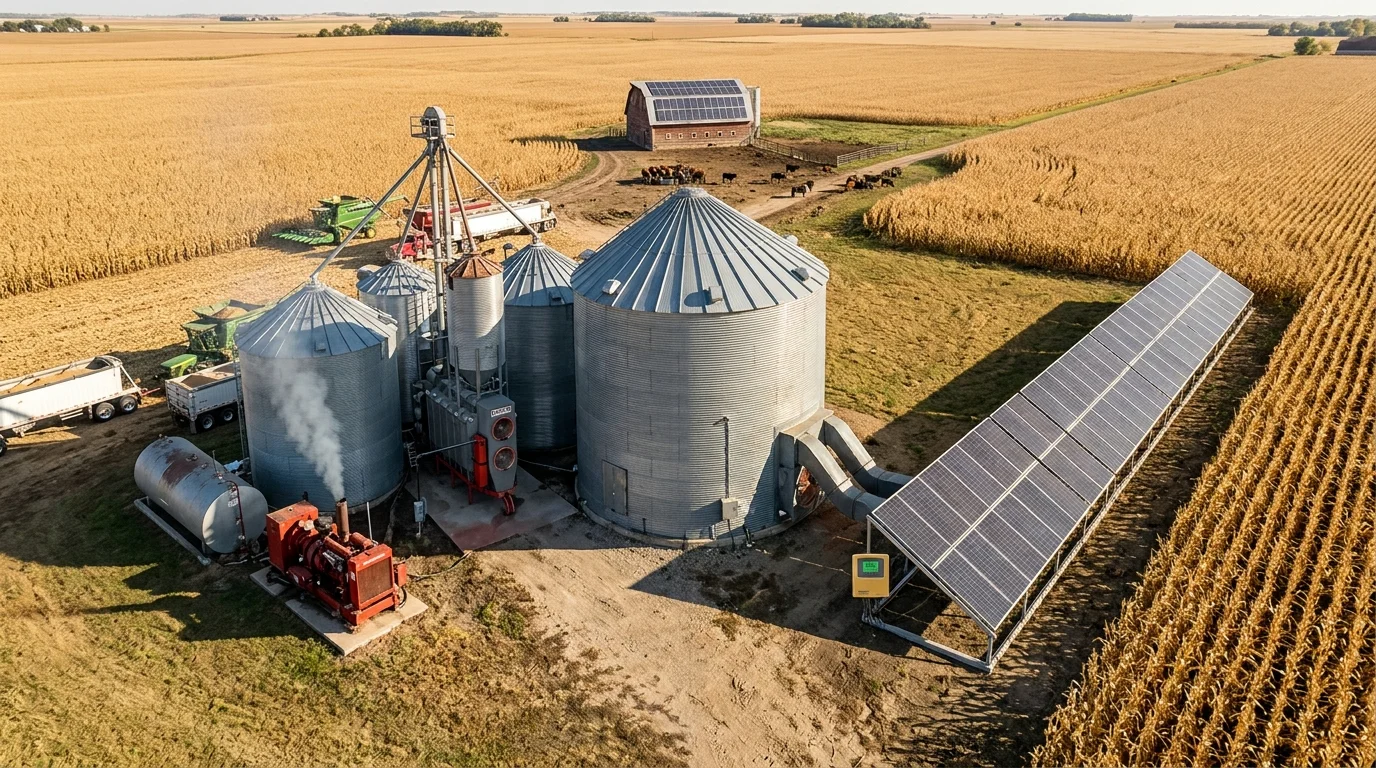
Drying corn from 20% to 15% moisture with a diesel-fired continuous dryer burns roughly 0.02 gallons of diesel per bushel per point of moisture removed. For a 50,000-bushel harvest, that is 10,000 gallons — about $36,000 per season at 2026 off-road prices. A solar pre-heating setup — solar air heaters pushing 20–30°F warmer air into your natural-air bins — cuts diesel use by 60–70% and pays back in under two seasons.
I have designed or audited 11 solar-assisted drying systems since 2018. Not one of them has failed to pay back. The only variable is how fast.
Why Grain Drying Is the Hidden Fuel Bomb of Your Operation
Ask a farmer what his diesel bill is, and he thinks of the tractor. But a wet harvest can quietly make drying the second-largest fuel load on the farm — and unlike field work, you cannot defer it. Corn at 20% moisture does not wait.
The physics work against you: every point of moisture you remove requires evaporating roughly 1.2 pounds of water per bushel, and that evaporation takes heat — about 2,000 BTU per pound of water. A 50,000-bushel harvest at 20%→15% means removing 300,000 pounds of water, which needs roughly 600 million BTU of heat. Delivered by diesel at 138,000 BTU/gallon with 70% burner efficiency: about 6,200 gallons minimum, before losses — and real-world systems with leaky bins and over-drying routinely hit 8,000–10,000 gallons.
This is precisely why solar pre-heating matters: it attacks the largest, most predictable fuel load in your harvest, during the season with surprisingly good sun.
By the Numbers
Solar-Assisted vs Diesel-Only Drying (50,000 bu corn, 20%→15%) – Farm Solar Guide
| Metric | Diesel-Only | Solar-Assisted |
|---|---|---|
| Fuel per season | 10,000 gal | 3,500 gal |
| Fuel cost per season | $36,000 | $12,600 |
| Drying equipment | $28,000 (continuous dryer) | Existing bins + fans |
| Solar addition cost | — | $14,500 |
| Total drying time (wet year) | 31 days | 27 days |
| Payback on solar addition | — | 1.9 seasons |
| 10‑year fuel total | $360,000 | $126,000 |
10-year savings from the solar addition: $234,000.
The Real Cost Breakdown
Solar does not replace your diesel dryer. It works upstream of it — pre-heating the air so the diesel burner runs a fraction of the hours:
- Solar air heater modules: 8–12 × 4×8 ft collectors at $1,000–1,200 each = $8,800–14,400
- Ducting, 24V DC axial fans, controls: $3,700
- Moisture monitoring system (cables, handheld meter, bin sensors): $2,000
- Mounting hardware, misc.: $800
- Total solar addition: $14,500–21,000 on top of your existing bins and fans
The physics in your favor: every 10°F of air pre-heat reduces the moisture-holding deficit your diesel burner must make up, cutting burner hours by roughly 15–20%. Harvest season (September–November) also delivers 4–5 peak sun hours/day across the Corn Belt — exactly when you need it. And unlike fuel, solar heat arrives at its highest output precisely on the cold, clear, low-humidity days that are best for drying.
Field Report: Hansen Family Farms, Iowa
The Hansens farm 1,800 acres of corn and soybeans near Fort Dodge. Their 2018 diesel continuous dryer consumed 11,200 gallons in the wet 2024 harvest — a $40,300 fuel bill for a single season. That bill was the trigger for my phone call with them in January 2025.
We designed a solar pre-heating retrofit for their two 25,000-bushel bins:
- 12 solar air heater modules on a 45° south-facing rack
- 3 × 24V DC axial fans (1,200W total, running solar-direct — no grid draw)
- Existing 200,000 BTU diesel dryer retained as the finishing unit
Results, 2025 harvest (an equally wet year — 19.8% average moisture):
| Metric | 2024 (Diesel-Only) | 2025 (Solar-Assisted) |
|---|---|---|
| Diesel used | 11,200 gal | 3,900 gal |
| Fuel cost | $40,300 | $14,000 |
| Drying time | 31 days | 27 days |
| Energy cost per bushel | $0.81 | $0.28 |
Savings in one season: $26,300. Payback on the $14,500 solar addition: 0.6 seasons. Mr. Hansen’s summary: “The dryer used to be the thing I worried about every October. Now I watch the sun do my job.”
Where Diesel Still Wins
I will not pretend solar pre-heating is universal. Diesel-only remains the right answer when:
- Corn comes in above 25% moisture. Solar pre-heat handles the first 60% beautifully, but finishing high-moisture corn in November requires the full heat of a column dryer. The hybrid approach — solar first, diesel finish — is what my designs always specify.
- You have no existing bins or fans. If you are building from zero and drying 100,000+ bushels/year, a dedicated continuous-flow system is operationally simpler, whatever the fuel.
- Back-to-back cloudy Septembers. Solar output drops ~40% in an overcast stretch; your diesel burner picks up the slack. Size the solar for the average year, not the dream year.
- Very small operations (< 10,000 bu/year). The $14,500 fixed cost never amortizes at that volume.
5 Rules Before You Switch
- Insulate the bin first. An uninsulated bin roof radiates away up to 30% of your heat gain — solar or diesel. R-19 to R-30 on the roof pays for itself in one season, whatever heats your air.
- Size solar for CFM, not BTU. Fans move air; solar collectors heat it. A 1,200W solar fan array properly serves a 25,000-bushel bin. Get airflow right before you add heat.
- Monitor moisture hourly, not daily. Solar drying is gentler and slower per pass — which is an advantage for kernel quality — but it demands closer monitoring to avoid over-drying shrink losses at the elevator. Over-drying to 13% when the contract says 15% is throwing away bushels.
- Angle collectors at 45–50°, not “optimal annual.” The textbook optimal tilt for annual energy is your latitude. But you only care about September–November, when the sun rides low. Steeper tilt beats annual optimization by 15–20% during harvest.
- Keep the diesel burner as the finisher. Let solar do the first 60–65% of moisture removal in the bin; let diesel finish. This division of labor is where the 60–70% fuel savings come from — trying to go 100% solar in a wet year is how you get moldy corn and a $40,000 loss that erases a decade of fuel savings.
Frequently Asked Questions
Q: Does solar drying work for soybeans and wheat?
Yes — and arguably better. Wheat and soybeans dry at lower temperatures, which is exactly the operating range of solar air heaters. Many of my clients run solar-only (no diesel at all) for these crops, using the diesel unit only for corn.
Q: What happens at night and on cloudy days?
Drying slows but does not stop. Stored heat in the grain mass plus reduced airflow overnight keeps the moisture front moving slowly through the bin. On multi-day cloudy stretches, the diesel burner tops off. The hybrid never sleeps; it just changes which energy source is working.
Q: How long do solar air heaters last?
Commercial modules carry 20–25 year warranties and have no moving parts. The DC fans are the wear item — budget $300–400 per replacement every 8–10 years. Compare that to a diesel burner’s annual service alone.
Q: Can I get a grant for this?
Frequently, yes. USDA REAP cost-shares (typically 25–50%) apply to solar-assisted drying as an energy-efficiency improvement for agricultural producers, and several Corn Belt states stack additional incentives. Of the 11 systems I’ve designed, 7 received some grant support.
Related Articles:
- For the seasonal overview, read Solar Grain Drying: Cut Your Propane Bill During Harvest Season
- For fan and motor sizing, see How to Wire a 12V DC Solar Fan in Your Barn or Greenhouse
© 2026 Farm Solar Guide. All data sourced from ASAE D245 drying equations, Iowa State Extension cost data, NREL solar datasets, and documented US grain operations. Last verified: September 16, 2026.