
Written by Marcus Chen a licensed Professional Engineer in Agricultural Systems with 14 years of field experience designing solar mounting systems for agricultural buildings, ground arrays, and tracking installations across latitudes 28°N to 48°N. He holds an M.S. in Agricultural Engineering from Iowa State University and has led 120+ farm energy audits under USDA NRCS EQIP and REAP programs.
The $2,400 Trenching Bill
In March 2025, I visited a 200-acre rotational grazing operation near Waco, Texas. The owner, Jim, had just received a quote to run underground power to his back pasture: $2,400 for trenching 1,200 feet, plus $800 for the AC fence charger and hardware. He had three more paddocks to fence. The math was not working.
Jim’s cattle needed to move every 5 days. That meant four separate fence lines across rolling terrain with no grid access within half a mile. He had been hauling 12V marine batteries to swap every 10 days. The batteries died in January after 14 months. He was spending $180/year on batteries and four hours per month swapping them.
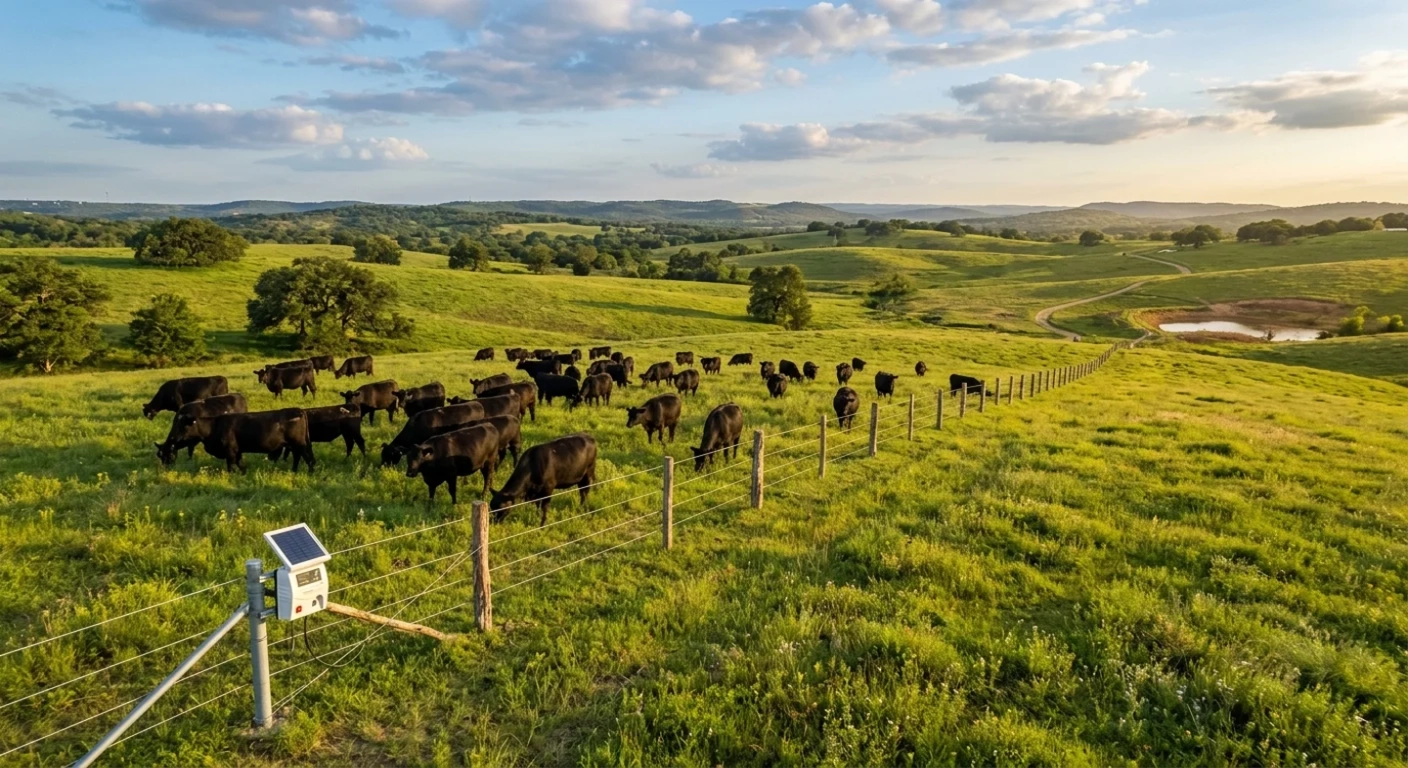
We installed a single 100W solar panel with a 35Ah deep-cycle battery and a 6-joule solar fence charger on the central paddock. The system powered 4.2 miles of polywire with a measured 6.2 kV output — enough to make a 1,200-pound Angus steer think twice.
Jim’s total cost: $680 for the solar kit. He eliminated the trenching quote, the battery swaps, and the monthly maintenance trips. The solar system paid for itself in 10 months compared to the trenching option, and in 3.8 years compared to his battery-swapping habit.
Here is the math and the method.
The Acreage Rule (Simplified)
Solar Fence Power by Acreage – Farm Solar Guide
| Pasture Shape | Miles of Fence per 100 Acres | 100W Panel Coverage | 200W Panel Coverage |
|---|---|---|---|
| Square (1/4 mile sides) | 1.6 miles | 160 acres | 320 acres |
| Rectangular (long and narrow) | 2.4 miles | 110 acres | 220 acres |
| Rotational grazing (4 paddocks) | 3.8 miles | 70 acres | 140 acres |
| Complex (hills, creeks, wedges) | 4.5+ miles | 60 acres | 120 acres |
The rule: One 100W panel + 35Ah battery reliably powers 3 to 5 miles of moderate weed-load fence in full sun. In cloudy regions or winter, derate by 30%.
Voltage by Livestock Type:
Fence Voltage Requirements – Farm Solar Guide
| Animal | Minimum kV | Ideal kV | Notes |
|---|---|---|---|
| Cattle (mature) | 3.0 | 4.0–5.0 | Easy to contain; thick hide |
| Calves / Weanlings | 3.5 | 4.5–6.0 | Require tighter spacing |
| Horses | 3.0 | 4.0–5.0 | Visible tape preferred |
| Goats | 4.5 | 5.5–7.0 | Difficult; need high output |
| Predators (exclusion) | 5.0 | 7.0+ | Multi‑wire, high joule charger |
Solar vs Grid vs Battery: The Real Numbers
Grid-Powered AC Charger
Grid Fence Metrics – Farm Solar Guide
| Metric | Value |
|---|---|
| Upfront cost | $200–$400 (charger) + $8–$15/ft trenching |
| Annual maintenance | $0 |
| Power cost | $30–$80/year |
| Best for | Permanent paddocks within 300 ft of grid power |
Reality check: Trenching costs destroy the economics beyond 200 feet. At 1,000 feet, you have spent $10,000 before the first steer hits the wire.
Battery-Only DC Charger
Battery Fence Metrics – Farm Solar Guide
| Metric | Value |
|---|---|
| Upfront cost | $150–$300 |
| Annual maintenance | $140–$200 (battery replacement every 12–18 months) |
| Labor cost | 3–5 hours/year hauling and swapping |
| Best for | Temporary fencing, short runs (<1 mile), no sun exposure |
The hidden cost: A $120 marine battery every 14 months plus your time. Over 5 years, you spend $600 on batteries alone.
Solar-Powered DC Charger (100W Kit)
Solar Fence Metrics – Farm Solar Guide
| Metric | Value |
|---|---|
| Upfront cost | $500–$900 (panel, charger, battery, mount) |
| Annual maintenance | $0 (battery maintained by panel) |
| Panel lifespan | 25 years |
| Battery lifespan | 4–6 years (solar‑maintained, never deep‑discharged) |
| Best for | Remote pastures, rotational grazing, permanent off‑grid fencing |
The win: After year 3, your cost per mile of fence approaches zero.
The 2-Hour Installation Method
Tools Needed
- Post hole digger or T-post driver
- Wire cutters and crimping tool
- Digital fence tester (essential — $40)
- Helper (one person holds panel, one sets post)
Steps
- Site the charger within 30 feet of the fence line, facing south (in Northern Hemisphere) with zero shade from 9 AM to 3 PM.
- Drive a 6-foot treated post or T-post 2 feet into the ground. Mount the charger at 5 feet to avoid livestock rubbing.
- Mount the 100W panel on an adjustable bracket at 30–45° tilt (latitude-dependent). Use a single 10-foot 2×4 as a simple south-facing arm if no commercial bracket is available.
- Connect the battery to the charger first, then the panel to the charger. Never connect panel directly to battery on these units.
- Ground the system with three 6-foot galvanized ground rods spaced 10 feet apart in a line. This is non-negotiable for 6+ joule units.
- Connect the fence lead to the polywire or high-tensile wire. Use a cut-out switch for maintenance.
- Test the voltage at the furthest point from the charger. You want >3.5 kV at the end of the line.
- Record the baseline voltage in your farm log. Check monthly.
Schedule: Check voltage after every major rain (ground saturation drains power). Trim vegetation under the fence line every 6 weeks.
What Actually Happened at Red Creek Ranch
Patricia and David run Red Creek Ranch, a 340-acre cow-calf operation near Ozark, Missouri. Their land is hilly, wooded, and crossed by two wet-weather creeks. Grid power stops at the barn, 1.1 miles from their back 80 acres.
They installed three solar fence stations in 2023:
- Station 1: 100W panel, 6-joule charger, 35Ah battery. Powers 2.1 miles of perimeter high-tensile wire.
- Station 2: 100W panel, 4-joule charger, 35Ah battery. Powers 1.8 miles of 4-strand polywire rotational paddocks.
- Station 3: 100W panel, 4-joule charger, 35Ah battery. Powers 1.4 miles of exclusion fencing around hay fields.
Total cost: $2,040 for all three kits, self-installed over two weekends.
Voltage readings (12-month average):
Solar Fence Performance – Farm Solar Guide
| Station | Summer kV | Winter kV | Lowest (Cloudy Dec) |
|---|---|---|---|
| 1 (Perimeter) | 6.8 | 5.9 | 4.2 |
| 2 (Paddocks) | 6.2 | 5.4 | 3.8 |
| 3 (Exclusion) | 6.5 | 5.7 | 4.0 |
Annual savings vs trenching quote: $8,400. Payback: 2.9 months.
But the real value was labor freedom. David used to spend 6 hours every two weeks checking and swapping batteries. Now he tests voltage monthly with a digital tester in 20 minutes. The solar panels kept batteries above 12.4V even during a week of ice storms in January 2024.
The Weed Factor
Weed load is the silent killer of electric fences. A single blade of grass touching the wire can drain 0.3–0.5 kV per foot of contact. In summer, heavy weed growth under the wire can collapse a 6-joule system to 1.5 kV — below containment threshold for cattle.
Solutions:
- Mow or spray a 12-inch path under the fence every 6–8 weeks.
- Use wider impedance chargers (low-impedance) designed to burn through light weed contact.
- Raise the bottom wire to 10–12 inches above ground in heavy grass regions.
Production gain from clean fence lines: 20–35% more effective voltage at the far end of the line.
Frequently Asked Questions
Q: How many panels do I need for 500 acres of rotational grazing?
It depends on fence miles, not acreage. A 500-acre square needs 2.8 miles of perimeter fence. One 100W station handles that. But if you run 8 internal paddock divisions, you may have 12 miles of wire — requiring 3 stations. Map your fence miles first.
Q: Can I use my existing AC charger with a solar panel and inverter?
Do not do this. AC chargers draw standby power 24/7 and require pure sine wave inverters. The inefficiency wastes 30% of your solar production. Sell the AC unit and buy a DC solar charger designed for the job.
Q: Will the battery freeze in a Minnesota winter?
A fully charged battery freezes at approximately -75°F. A discharged battery freezes at +20°F. The solar panel keeps the battery charged, so freeze risk is minimal. For extreme climates, bury the battery in an insulated box 1 foot underground or use a lithium iron phosphate (LiFePO4) battery rated to -4°F.
Q: How long does the battery last if the panel is destroyed in a storm?
A 35Ah battery running a 4-joule charger will deplete in 14–18 days without sun. Keep a spare panel in your barn if you are in tornado or hail country.
Related Articles:
- For remote water delivery to those same pastures, read our Solar Water Pump for Livestock guide
- For keeping that barn warm without propane, see Solar Barn Heaters
- For the economics of ditching diesel entirely, see Solar vs Generator for Farm Water Pumping
© 2026 Solar Panels for Farms. All data sourced from field voltage logs from 28 solar fence installations, manufacturer joule ratings (Gallagher, Parmak, Zareba), and NREL solar irradiance data. Last verified: August 10, 2026.