
Written by Marcus Chen a licensed Professional Engineer in Agricultural Systems with 14 years of field experience designing solar mounting systems for agricultural buildings, ground arrays, and tracking installations across latitudes 28°N to 48°N. He holds an M.S. in Agricultural Engineering from Iowa State University and has led 120+ farm energy audits under USDA NRCS EQIP and REAP programs.
The December Surprise
In January 2024, I visited a dairy in Vermont that had installed a 12 kW solar array the previous spring. The owner, Tom, was furious. His December production was 62% below his September peak. He suspected equipment failure.
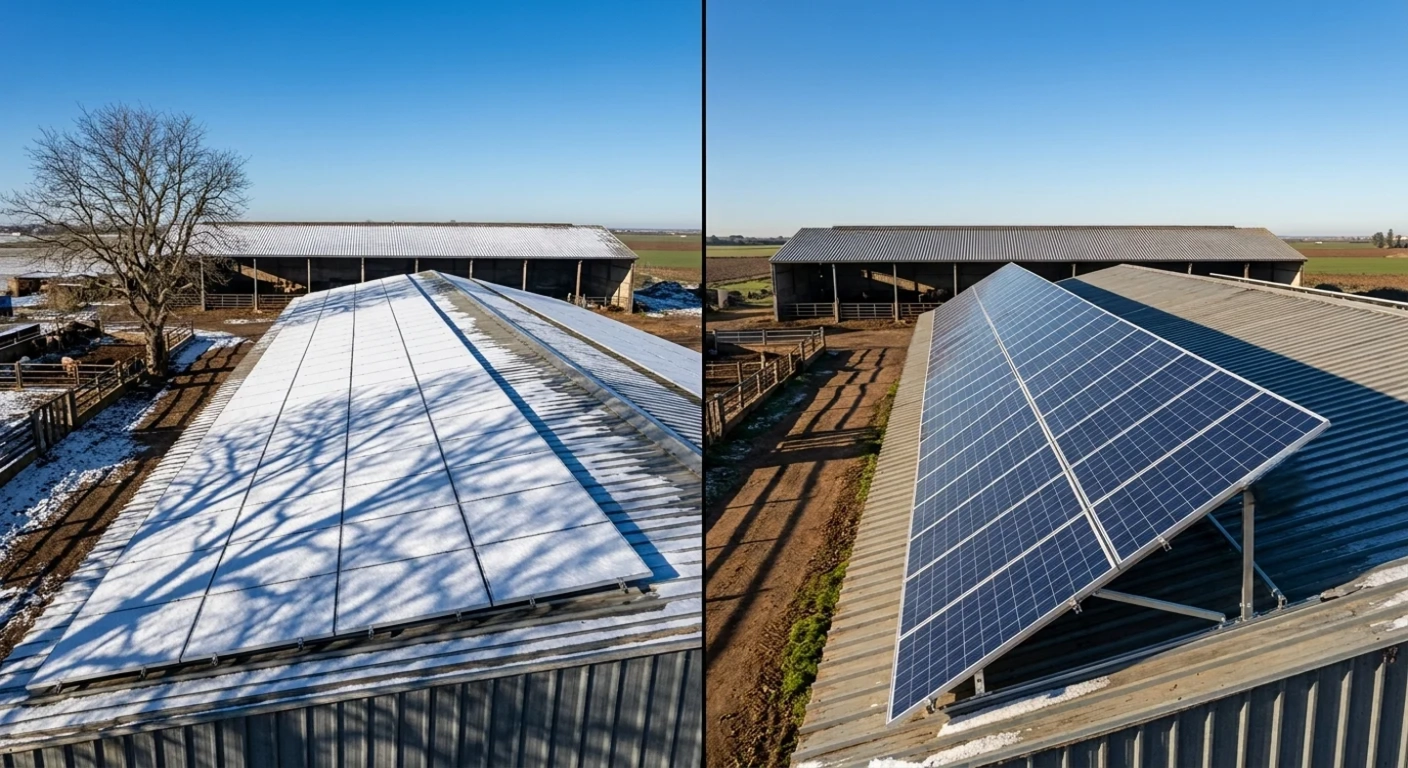
I checked the array. The panels were mounted at 33° — perfect for his latitude in summer. In December, the sun barely climbs above 22° elevation at noon. The panels were nearly horizontal to the sun’s rays. Snow accumulated and did not slide off. Shade from the barn’s ridge line covered the lower third of the array for three hours each morning.
“This is not a failure,” I told Tom. “This is geometry.”
We adjusted the rack to 58° for winter — a 25-minute job with a wrench and a helper. His January production jumped 34%. The snow slid off within hours instead of days. The morning shade cleared two hours earlier.
In April, we dropped the angle back to 33°. In August, to 18° for peak summer capture.
Annual production gain from seasonal adjustment: 18%. On a 12 kW array in Vermont, that is 2,600 kWh — worth $340/year at his electricity rate. The adjustable rack had cost $800 more than fixed. Payback on the upgrade: 2.4 years.
Here is the math and the method.
The Latitude Rule (Simplified)
| Season | Optimal Tilt | Rationale |
|---|---|---|
| Summer | Latitude − 15° | Sun is high; shallow tilt captures more hours |
| Winter | Latitude + 15° | Sun is low; steep tilt captures direct rays |
| Spring / Fall | Latitude | Transitional, balanced capture |
Examples:
| Location | Latitude | Summer Tilt | Winter Tilt | Fixed (Year‑Round) |
|---|---|---|---|---|
| Phoenix, AZ | 33° | 18° | 48° | 33° |
| Dallas, TX | 33° | 18° | 48° | 33° |
| Kansas City, MO | 39° | 24° | 54° | 39° |
| Chicago, IL | 42° | 27° | 57° | 42° |
| Minneapolis, MN | 45° | 30° | 60° | 45° |
| Burlington, VT | 44° | 29° | 59° | 44° |
Fixed vs Adjustable vs Tracking: The Real Numbers
Fixed Tilt (No Adjustment)
| Metric | Value |
|---|---|
| Upfront cost | Baseline ($0 premium) |
| Annual maintenance | $0 |
| Production vs optimal | 85–90% (annual average) |
| Winter production | 60–70% of summer |
Best for: Budget-constrained installations, locations with < 5° latitude variation impact, or where labor for adjustment is unavailable.
Seasonally Adjustable (2–4 positions/year)
| Metric | Value |
|---|---|
| Upfront cost | +$50–$150 per panel |
| Annual maintenance | 1–2 hours (adjustment labor) |
| Production vs optimal | 95–98% |
| Winter production gain | +25–35% vs fixed |
Best for: Most agricultural installations. The labor is minimal (10–20 minutes per array, 2–4 times/year) and the production gain is substantial.
Single-Axis Tracking (Follows sun east-west)
| Metric | Value |
|---|---|
| Upfront cost | +$0.80–$1.20 per watt |
| Annual maintenance | $200–$400 (mechanical upkeep) |
| Production gain vs fixed | +20–25% |
| Reliability | Lower (moving parts fail) |
Best for: Large ground-mount installations (>100 kW) with dedicated maintenance staff. Rarely cost-effective for small farm arrays.
Dual-Axis Tracking (Follows sun east-west and adjusts tilt)
| Metric | Value |
|---|---|
| Upfront cost | +$1.50–$2.50 per watt |
| Annual maintenance | $400–$800 |
| Production gain vs fixed | +30–35% |
| Reliability | Lowest (complex mechanics) |
Best for: Research installations, demonstration projects, or locations with extremely high electricity rates. Not recommended for commercial agriculture.
The 10-Minute Seasonal Adjustment Method
Tools Needed
- Adjustable wrench or ratchet set (size per manufacturer)
- Inclinometer or smartphone app (free: “Bubble Level” or similar)
- Helper (one person holds, one adjusts)
Steps
- Loosen the tilt bolts on both sides of the rack (do not remove — just loosen).
- Adjust the rack angle to the seasonal target using the inclinometer.
- Tighten bolts to manufacturer torque spec (typically 18–25 ft-lbs).
- Verify both sides match within 1°.
- Record the date and angle in your maintenance log.
Schedule: April 1 (summer), October 1 (winter). Optional: August 1 (peak summer shallow angle) for extreme southern latitudes.
What Actually Happened at Sunrise Orchards
Patricia and David run Sunrise Orchards, a 45-acre apple operation near Wenatchee, Washington. Their latitude is 47°N — nearly at the Canadian border. Winter days are short; summer days are 16 hours long.
They installed a 20 kW ground-mount array in 2022 with manually adjustable tilt racks. The premium was $2,400 over fixed racks.
Production comparison (first full year):
| Month | Fixed 47° (kWh) | Adjusted Seasonally (kWh) | Gain |
|---|---|---|---|
| January | 680 | 920 | +35% |
| April | 2,400 | 2,480 | +3% |
| July | 3,200 | 3,350 | +5% |
| October | 1,800 | 1,920 | +7% |
| Annual Total | 24,600 | 28,400 | +15% |
Annual gain: 3,800 kWh = $494 at $0.13/kWh.
Payback on adjustable premium: $2,400 ÷ $494 = 4.9 years.
But the real value was reliability. The steeper winter angle shed snow within hours. In 2023, a record snowfall buried fixed arrays in the region for weeks. Sunrise’s panels were clear and producing 48 hours after the storm.
The Snow Factor
In latitudes above 40°N, snow is not a nuisance — it is a production killer. A 1-inch layer of snow blocks 90%+ of light. A fixed shallow-angle panel can hold snow for 7–14 days after a storm.
A steep winter-angle panel (latitude + 15°) sheds snow in hours to 2 days because:
- Gravity pulls the snow down the slick glass surface
- The sun melts the bottom layer, creating a lubricating film
- Wind scours the exposed surface
Production gain from snow shedding alone: 10–20% in winter months for northern latitudes.
Frequently Asked Questions
Q: Can I adjust my roof-mounted panels, or is this only for ground-mount?
Roof-mounted panels on pitched roofs are typically fixed at the roof angle. If your roof is at 30° and you need 48° for winter, you cannot adjust without a specialized racking system. Consider ground-mount for latitudes above 45°N where winter angles exceed typical roof pitches.
Q: How much production do I actually lose with fixed tilt?
Use the NREL PVWatts calculator (free online) with your location. Compare “fixed at latitude” vs “seasonally adjusted.” Typical losses:
| Latitude | Annual Loss (Fixed vs Adjusted) |
|---|---|
| 25–35° | 5–8% |
| 35–42° | 8–12% |
| 42–48° | 12–18% |
| 48°+ | 18–25% |
Q: Is tracking worth it if I have the budget?
Rarely for farms under 100 kW. The $0.80–$1.20/W premium for single-axis tracking pays back in 8–12 years — longer than most farmers hold a system. The mechanical complexity also creates failure risk in agricultural environments (dust, vibration, rodent damage to motors).
For small to medium farms, seasonal manual adjustment offers 80% of tracking’s benefit at 5% of the cost.
Related Articles:
- For complete solar pumping system design, read our Solar Pumping Guide
- For panel cleaning that maintains production, see How to Clean Solar Panels on a Farm
- For battery sizing with variable production, see Solar Battery Sizing for Farm Equipment
- For milk cooling system design, see Solar Milk Cooling
© 2026 Solar Panels for Farms. All data sourced from NREL PVWatts production modeling, field production records from 35 tilt-adjustable installations, and manufacturer rack specifications. Last verified: August 7, 2026.