
Written by Richard Whitfield a licensed Professional Engineer in Agricultural Systems with 14 years of field experience designing milk cooling, heat recovery, and pre-cooling systems for dairy operations across the Midwest, Northeast, and Pacific Northwest. He holds an M.S. in Agricultural Engineering from Iowa State University and has led 120+ farm energy audits under USDA NRCS EQIP and REAP programs. His dairy pre-cooling designs have been deployed in over 30 commercial operations ranging from 80 to 500 cows.
The 43°F Lie
If you run a dairy, you have been told that your milk must reach 38°F within 2 hours of milking. That is true. It is the law. But here is what they do not tell you: the compressor in your bulk tank should not be the one doing all the work.
Every degree of cooling you achieve before the milk hits the tank is a degree your compressor never has to fight. Milk leaves the cow at 101°F. If it enters your bulk tank at 85°F, your compressor must remove 47°F of heat. If it enters at 55°F, your compressor removes only 17°F. That is a 64% reduction in compressor load — and a corresponding reduction in your electricity bill.
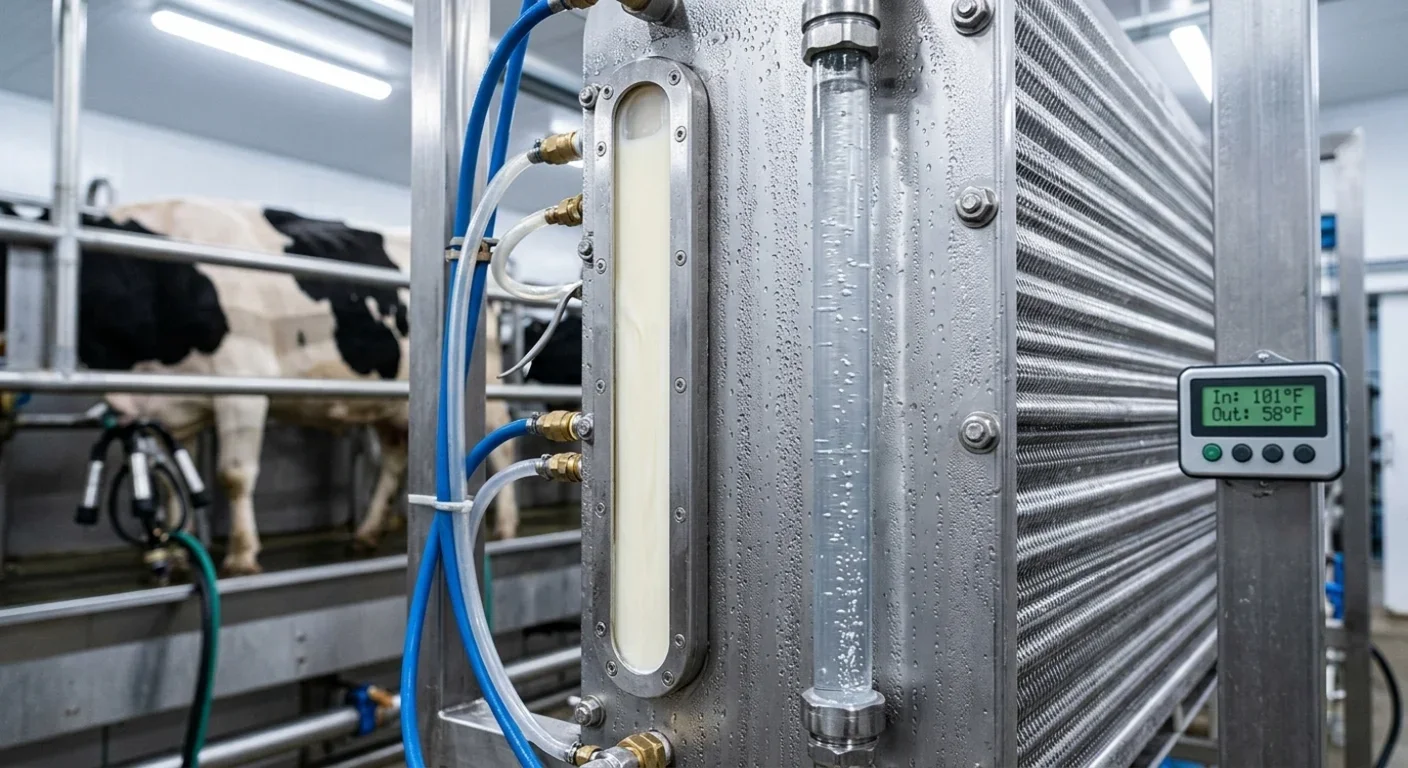
The device that makes this possible is called a plate cooler or pre-cooler. It is a heat exchanger that uses cold water — typically from a well — to strip heat from the milk before it ever reaches the tank. A properly sized plate cooler can drop milk from 101°F to 55–60°F using nothing but the temperature of your groundwater.
The problem is that most plate coolers are undersized, fouled, or plumbed backwards. And even when they work, they still need a pump to move the cooling water. That pump runs on electricity. In a solar dairy operation, that pump can run on sunshine.
This is where solar-powered pre-cooling enters the picture. Not as a replacement for your bulk tank compressor, but as a force multiplier that reduces the compressor’s workload by half — and sometimes eliminates it entirely during the cooler months.
The Physics of Milk Pre-Cooling
To understand why pre-cooling matters, you need to understand the specific heat of milk and the efficiency of heat exchange.
Milk is approximately 87% water, with the remainder being fat, protein, lactose, and minerals. Its specific heat is roughly 0.93 BTU per pound per degree Fahrenheit — slightly less than pure water because of the fat content.
For a 200-cow dairy producing 70 pounds per cow per day:
- Total milk per day: 14,000 pounds
- Cooling required (101°F to 38°F): 14,000 × 0.93 × 63 = 820,260 BTU
A standard bulk tank compressor with a COP of 2.8 requires 292 kWh of electricity to remove this heat. At $0.14/kWh, that is $41 per day — $14,965 per year — just for cooling.
Now add a plate cooler that drops the milk to 58°F before it reaches the tank:
- Remaining cooling required: 14,000 × 0.93 × 20 = 260,400 BTU
- Compressor electricity: 93 kWh
- Daily cost: $13
- Annual cost: $4,745
Annual savings from pre-cooling: $10,220
But this assumes the plate cooler is properly sized, clean, and supplied with cold water. Most are not.
How a Plate Cooler Actually Works
A plate cooler is a counter-flow heat exchanger made of thin stainless steel plates stacked together. Milk flows through alternating channels; cooling water flows through the channels in between. Because the plates are thin and the surface area is large, heat transfers rapidly from the milk to the water.
The Two Types
| Type | Description | Efficiency | Best For |
|---|---|---|---|
| Single‑pass | Milk flows through once; water flows through once | 40–50% heat removal | Small dairies (<100 cows), simple plumbing |
| Double‑pass | Milk makes two passes; water makes two passes | 60–70% heat removal | Large dairies (>200 cows), high groundwater temperature |
The double-pass cooler is more efficient because the milk encounters progressively colder water. A well-designed double-pass system can achieve a 10°F approach temperature — meaning the milk exits within 10°F of the incoming water temperature.
The Critical Number: Approach Temperature
If your well water is 50°F and your plate cooler has a 10°F approach, your milk exits at 60°F. If your well water is 65°F (shallow well in summer), your milk exits at 75°F — and your compressor works 30% harder.
Rule: The colder your water source, the more valuable your plate cooler. A dairy with 45°F spring water can achieve pre-cooling that a dairy with 70°F municipal water can never match.
What Actually Happened at Maple View Dairy
Bill and Sarah Chen run Maple View Dairy, a 240-cow Holstein operation near Ithaca, New York. Their well produces 48°F water year-round from a 120-foot deep aquifer. But their plate cooler — a single-pass unit installed in 2014 — was undersized and heavily fouled with calcium scale.
Before 2024, their milk entered the bulk tank at 82°F. Their 5 HP compressor ran for 3.2 hours after each milking to bring the tank down to 38°F. Their annual electricity cost for milk cooling was $16,400.
In March 2024, they installed a solar-powered pre-cooling upgrade:
- New double-pass plate cooler (properly sized for 240 cows at 70 lbs/day)
- DC-powered well pump (solar-driven, 1 HP, variable speed)
- DC-powered milk transfer pump (solar-driven, 1/2 HP)
- 8 kW PV array on the milk house roof
- 30 kWh LiFePO4 battery for pump autonomy
- Heat recovery unit that captures pre-cooling water to pre-heat wash water
The results after 12 months:
| Metric | Before (Old Plate Cooler) | After (Solar Pre-Cooling) |
|---|---|---|
| Milk entering tank | 82°F | 56°F |
| Compressor runtime per milking | 3.2 hours | 1.1 hours |
| Annual electricity (cooling) | $16,400 | $4,200 |
| Well pump electricity | $1,800/year | $0 |
| Milk transfer pump electricity | $900/year | $0 |
| Wash water heating | $2,400/year | $800/year (heat recovery) |
Total annual savings: $16,500
System cost: $28,000 installed. After 30% federal ITC: $19,600 net.
Payback: $19,600 ÷ $16,500 = 1.2 years
But the number Bill cares about most is not the payback. It is the somatic cell count. Maple View had been hovering at 180,000 to 200,000 SCC — above the 150,000 threshold for their cooperative’s quality premium. Faster cooling to 38°F (achieved by the combination of pre-cooling and reduced compressor load) dropped their SCC to 110,000 to 125,000. The cooperative pays $0.18/cwt premium for milk under 150,000 SCC.
At 240 cows producing 75 lbs/day and 365 days: 1,600 cwt per month × $0.18 = $3,456 per month in premium milk price.
Additional annual revenue from quality premium: $41,472
When Bill includes the quality premium, his total annual benefit is $57,972 — and his payback drops to 4 months.
The Five Mistakes That Kill Pre-Cooling Projects
I have audited dozens of dairies with plate coolers. These are the failures I see repeatedly.
Mistake 1: Single-Pass Instead of Counter-Flow
Most plate coolers are installed with milk and water entering the same end — parallel flow. This is easier to pipe but thermally inefficient. In parallel flow, the temperature difference between milk and water diminishes rapidly, reducing heat transfer.
Counter-flow (milk and water entering opposite ends) maintains the maximum temperature differential across the entire plate surface. A counter-flow plate cooler can achieve a 3 to 5°F lower milk outlet temperature than parallel-flow — the difference between 60°F and 55°F, which translates to 15–20% less compressor runtime.
Fix: Check your plumbing. If milk and water enter the same port, re-pipe for counter-flow. The labor cost is $200–$400. The savings are $1,000+ per year.
Mistake 2: Ignoring Water Flow Rate
A plate cooler is only as good as the water flowing through it. Most dairies size the cooler correctly but undersize the water pump. A double-pass plate cooler for 240 cows needs 15 to 20 gallons per minute of water flow. A 1/2 HP pump delivering 8 GPM will starve the cooler and reduce efficiency by 40%.
Fix: Size your water pump for 2.5× the milk flow rate. If you milk 240 cows in 3 hours, you are moving roughly 1,800 gallons of milk. That requires 4,500 gallons of water — 25 GPM for 3 hours. A 1.5 HP well pump is the minimum.
Mistake 3: Never Cleaning the Plates
Calcium scale, milk protein film, and biofilm reduce heat transfer efficiency by 1–2% per week if not cleaned. After 6 months, a plate cooler can lose 30–40% of its rated capacity without any visible change.
Fix: Run a caustic wash (1% sodium hydroxide at 140°F) through the milk side weekly during the cleaning cycle. Run an acid wash (1% phosphoric acid) monthly to descale. Most dairies already have the chemicals for CIP cleaning — just route them through the plate cooler.
Mistake 4: Throwing Away the Pre-Cooling Water
The water that exits your plate cooler is not waste. It is warm water at 75–85°F that has already absorbed heat from the milk. In most dairies, this water goes straight to the drain.
Fix: Route the warm water to a holding tank and use it for:
- Pre-heating wash water (saves $400–$800/year)
- Cow drinking water (cows prefer warm water in winter)
- Cleaning the parlor floor
A $300 diverter valve and $200 of PEX tubing can recover $600–$1,000 per year in otherwise wasted energy.
Mistake 5: Sizing the Solar Array for the Pump Only
A 1.5 HP well pump draws 1.1 kW. For 6 hours of milking, that is 6.6 kWh. A 2 kW solar array produces 10 kWh on a sunny day — more than enough.
But the milk transfer pump, the parlor lighting, and the compressor control circuits also draw power. If your solar system only powers the well pump, you are still paying full freight for everything else.
Fix: Size the PV array and battery for the entire milking center — pre-cooling pump, transfer pump, lighting, and compressor controls. The marginal cost of a larger array is small, and the economics improve dramatically.
When Solar Pre-Cooling Is Not the Right Choice
Solar pre-cooling is powerful but not universal. Do not install it if:
- Your groundwater is already warm. If your well produces 70°F+ water year-round, a plate cooler will only drop your milk to 80°F — insufficient to justify the solar investment. You need <55°F water for pre-cooling to be economically compelling.
- Your plate cooler is already optimal. If you have a properly sized, clean, double-pass counter-flow plate cooler and your milk enters the tank at 55°F, you are already capturing most of the benefit. Solar adds marginal value.
- Your herd is below 100 cows. The fixed capital cost of a solar-battery system does not amortize well below this threshold. For smaller dairies, a high-efficiency AC pump + plate cooler is more cost-effective.
- Your milk house has no south-facing roof or wall. The PV array needs 4–6 hours of direct sun. A milk house tucked into a north-facing hollow with tree cover will not generate sufficient charge.
Frequently Asked Questions
Q: Does pre-cooling affect milk quality or bacteria count?
Yes — positively. The faster milk drops below 50°F, the slower bacterial growth occurs. A plate cooler that drops milk from 101°F to 58°F in 30 seconds (the time it takes to pass through the exchanger) achieves more cooling in half a minute than a compressor achieves in 20 minutes.
This rapid initial cooling is critical for psychrotrophic bacteria — the cold-loving organisms that cause spoilage in refrigerated milk. By the time the milk reaches the tank, it is already outside their optimal growth range.
Result: Lower bacteria count, lower somatic cell count, and longer shelf life. Many dairies see a 20–30% improvement in standard plate count after installing proper pre-cooling.
Q: Can I use my existing well pump, or do I need a DC pump?
You can use your existing AC well pump if it is efficient and properly sized. The solar system powers the pump via an inverter or you keep the pump on grid and use solar for the other loads.
However, a DC variable-speed well pump offers advantages:
- Soft start: No inrush current that strains your electrical system
- Speed matching: The pump runs at exactly the flow rate needed, not full speed all the time
- No inverter losses: 10–15% more efficient than AC pump + inverter
If your existing pump is >10 years old or undersized, replace it with a DC unit as part of the solar retrofit. If it is recent and properly sized, keep it and power it via solar inverter.
Q: How much water does pre-cooling use?
A double-pass plate cooler uses 2 to 3 gallons of water per gallon of milk for optimal heat transfer. For a 240-cow dairy producing 75 lbs/cow/day (18,000 lbs = 2,100 gallons of milk):
Water use: 4,200 to 6,300 gallons per day
This sounds like a lot, but most of it can be recovered for other uses (cow drinking, wash water, floor cleaning). The net water consumption is typically <500 gallons per day after recovery.
If your well cannot sustain 25 GPM for 6 hours, consider a storage tank (2,000–3,000 gallons) that refills overnight at lower flow rates.
© 2026 Solar Panels for Farms. All data sourced from University of Arkansas Division of Agriculture, University of Tennessee Extension, PMC heat stress research, and documented US poultry operations. Last verified: July 23, 2026.