
Written by Richard Whitfield a licensed Professional Engineer in Agricultural Systems with 14 years of field experience designing ventilation, cooling, and environmental control systems for poultry, swine, and dairy operations across the Southeast, Midwest, and Great Plains. He holds an M.S. in Agricultural Engineering from Iowa State University and has led 120+ farm energy audits under USDA NRCS EQIP and REAP programs
The Number That Kills in Four Hours
If you manage a broiler house, you already know the number. You may not think about it every day, but it lives in the back of your mind, waiting for the wrong afternoon.
95°F.
Not outside. Inside. When the temperature inside your tunnel-ventilated house hits 95°F and your humidity climbs above 70%, your birds stop eating. At 100°F, they start panting. At 105°F, they die. Not one by one. By the hundreds. By the thousands.
A fully stocked 40,000-broiler house can lose 2,000 to 5,000 birds in a single afternoon if the ventilation fails. At $1.20 per bird market value, that is $2,400 to $6,000 in dead inventory. But the real cost is worse: the surviving birds are heat-stressed, their feed conversion is ruined for the remainder of the grow-out, and your integrator notes the mortality spike in your permanent record.
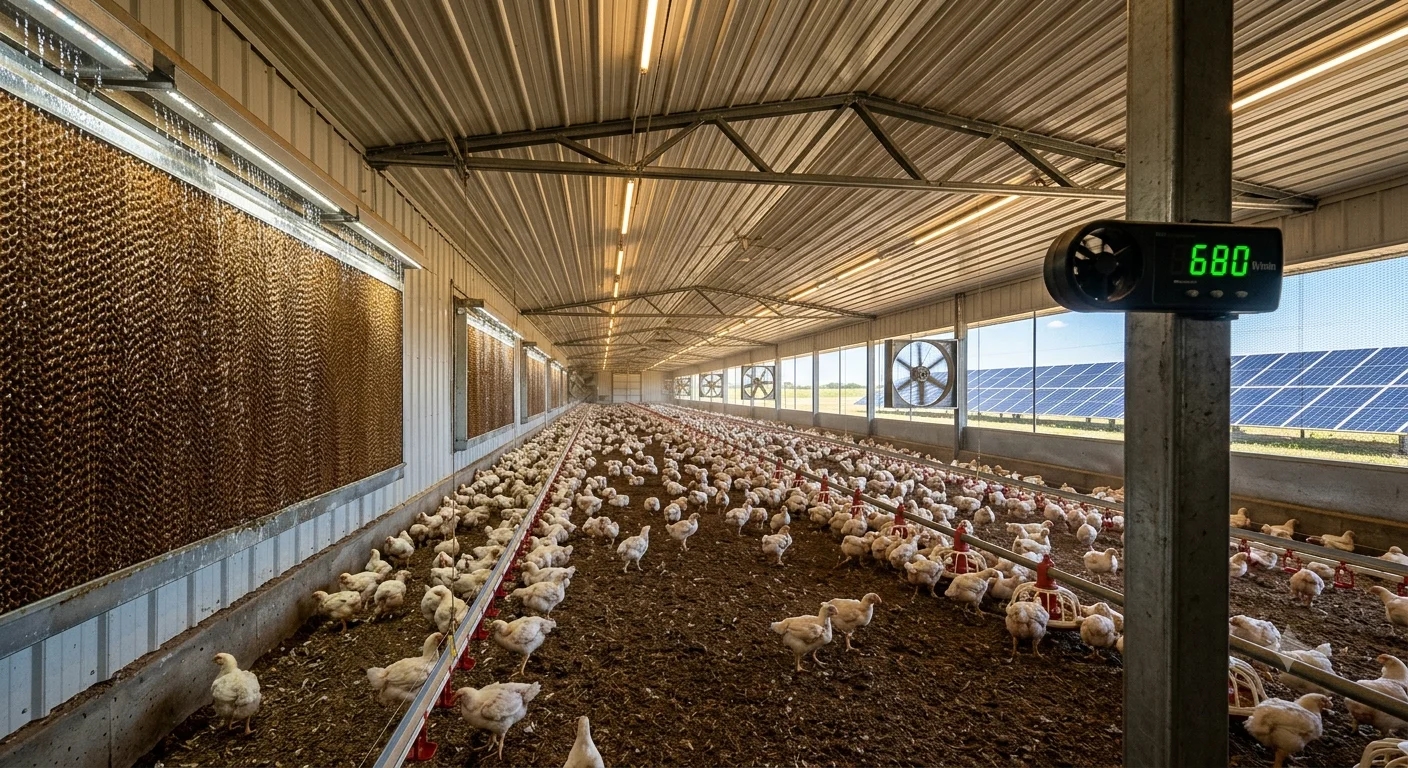
The traditional defense is tunnel ventilation: massive exhaust fans at one end, evaporative cooling pads at the other, pulling air through the house at 600 to 900 feet per minute. It works. But it is ferociously expensive to run. A 40,000-bird house requires six to eight 48-inch exhaust fans, each drawing 1.5 to 2.5 kW. In July, running at full speed for 14 hours a day, your ventilation system alone consumes 150 to 250 kWh daily. At $0.13/kWh, that is $20 to $32 per day. Over a 60-day summer grow-out, $1,200 to $1,900 in electricity — just for the fans.
And here is the part that keeps growers awake at night: the grid is not reliable. Rural cooperatives struggle with summer peak demand. A transformer failure at 2 PM on a 98°F day is not an inconvenience. It is a mass mortality event in progress.
This is where solar-powered tunnel ventilation enters the picture. Not as a green upgrade. Not as a tax write-off. As a survival system that keeps your birds alive when the grid goes down and your wallet intact when it stays up.
The Physics of Poultry Heat Stress
To understand why tunnel ventilation matters so much, you need to understand how a chicken sheds heat.
Humans sweat. Chickens do not. They have no sweat glands. Their only cooling mechanisms are:
- Panting: Rapid breathing that evaporates water from the respiratory tract. At 85°F, a broiler begins open-mouth panting. At 95°F, panting cannot keep up with metabolic heat production.
- Radiation: Heat loss to cooler surrounding surfaces. But when house temperature exceeds body temperature (105°F for a broiler), radiation reverses — the bird gains heat from the environment.
- Convection: Heat loss to moving air. This is where tunnel ventilation saves lives. At 600 ft/min airspeed, a broiler can dissipate 40% more heat than at 100 ft/min.
The thermoneutral zone for a modern broiler is roughly 65 to 75°F. Above 80°F, feed intake drops by 1.5% per degree Fahrenheit. Above 90°F, growth stalls. Above 95°F, mortality begins.
Your job as a grower is to keep the house inside that thermoneutral zone for as much of the 42-day grow-out as possible. In the Southeast, that means fighting ambient temperatures of 90 to 100°F for four to five months of the year.
How Tunnel Ventilation Actually Works
Tunnel ventilation is not complicated in principle. It is a wind tunnel with birds inside.
- Exhaust fans at one end wall (or both end walls) pull air out of the house.
- Air inlets or evaporative cooling pads at the opposite end allow fresh air to enter.
- The air moves down the length of the house at high velocity, creating wind chill that helps birds shed heat.
- The evaporative pads add humidity to the incoming air, which drops its temperature by 10 to 20°F through evaporative cooling.
The critical metric is air velocity at bird height: 600 to 900 ft/min for broilers, 400 to 600 ft/min for layers. Below 400 ft/min, the wind chill effect is insufficient. Above 1,000 ft/min, litter blows, feed scatters, and birds huddle away from the airflow.
The Power Demand
A 40,000-broiler house (40′ × 500′) requires:
| Component | Quantity | Power Each | Total Power |
|---|---|---|---|
| 48″ exhaust fans | 6 | 2.2 kW | 13.2 kW |
| 36″ circulation fans | 8 | 0.3 kW | 2.4 kW |
| Evaporative pad pump | 1 | 0.75 kW | 0.75 kW |
| Tunnel door actuators | 4 | 0.1 kW | 0.4 kW |
| Peak Load | — | — | 16.75 kW |
At full speed, this draws 70 to 80 amps at 240V. A 3-hour afternoon run consumes 50 kWh. Over 14 hours, 230 kWh.
Your electricity bill is not the problem. The problem is that you cannot afford for this system to stop.
How Solar Tunnel Ventilation Works
The concept is straightforward: replace your grid-powered AC exhaust fans, circulation fans, and cooling pad pumps with DC equivalents powered by a solar array and battery bank. The sun charges the batteries during the day. The batteries run the ventilation 24 hours per day. Your electricity meter for the house never spins.
But the implementation is where engineering matters. A poultry house is not a barn. It is a biological reactor that produces heat, moisture, and ammonia at industrial rates. The ventilation system must handle three distinct jobs simultaneously, and it must do so without ever stopping.
Job 1: The Tunnel (Exhaust Fans)
This is the heavy lifter. Large DC exhaust fans — typically 36″ to 54″ diameter, drawing 5,000 to 12,000 CFM each — mount at the end wall(s) and pull air through the length of the house. Fresh air enters through the cool pad wall or tunnel inlet doors, mixes with the interior air, and is expelled along with heat, CO₂, and moisture.
In a 40,000-bird house, you need total exhaust capacity equal to the house cross-section × target air velocity. For a 40′ × 9′ ceiling house at 700 ft/min:
CFM = 40 ft × 9 ft × 700 ft/min = 252,000 CFM
This typically requires six 48″ DC exhaust fans at 42,000 CFM each.
The key is variable speed. A DC fan running at 70% speed uses roughly 34% of the power of full speed (fan laws: power is proportional to the cube of speed). In spring and fall, when you only need 400 ft/min, the fans run at 50% speed. In summer, they ramp up automatically as house temperature rises. A house controller manages this seamlessly.
Job 2: The Mix (Circulation Fans)
Tunnel ventilation alone creates a problem: velocity stratification. Air moves fastest down the center of the house and slowest near the side walls. Birds in the corners and against the walls experience stagnant, hot air while birds in the center are blasted with wind.
DC circulation fans — typically 20″ to 24″ vertical mixing fans — break up these layers. They run continuously at low speed, creating vertical mixing that ensures uniform temperature and airspeed from wall to wall.
Power draw is minimal: 40 to 80W per fan. A 40,000-bird house needs 8 to 12 fans. Total continuous load: 400 to 960W — easily handled by even a modest solar-battery system.
Job 3: The Cool (Evaporative Pads)
In July and August, tunnel ventilation alone is not enough. When outside air temperature exceeds 85°F, the air you are bringing in is too hot to cool the birds. A 6-pound broiler generates roughly 10 BTU per hour of metabolic heat. Forty thousand birds generate 400,000 BTU per hour — the equivalent of a 117 kW heater running continuously.
Evaporative cooling pads — mounted at the air intake end of the tunnel — drop incoming air temperature by 10 to 20°F as hot outside air passes through wet cellulose media. A small DC pump circulates water over the pads. The pump draws only 300 to 500W, but it must run continuously during heat events.
The combination of cool intake air + high tunnel velocity + circulation mixing keeps the house at 75 to 80°F even when ambient temperatures hit 95 to 100°F.
What Actually Happened at Pine Ridge Farms
Jake and Melissa Carter run Pine Ridge Farms, a four-house broiler operation near Athens, Georgia. Each house holds 40,800 birds (Ross 708) on a 42-day grow-out cycle. Before 2024, they ran conventional AC tunnel ventilation: six 48″ exhaust fans, eight 20″ circulation fans, and a 1 HP evaporative pad pump per house. Their summer electricity bill was $2,400 per house per grow-out — just for ventilation.
More critically, they had two mortality events in 2023. In June, a transformer failure during a heat wave killed 3,200 birds in House 3 before backup power could be connected. In August, a voltage sag caused four of six fans to stall; 1,800 birds died before the issue was detected.
In March 2024, they retrofitted all four houses to solar DC tunnel ventilation:
- 18 kW PV array per house (ground-mounted, south-facing)
- 80 kWh LiFePO4 battery bank per house
- Six 48″ DC variable-speed exhaust fans per house (replacing the AC units)
- Ten 24″ DC vertical mixing fans per house
- Two 1/2 HP DC evaporative pad pumps per house (redundant)
- Integrated house controller with temperature, humidity, ammonia, and air velocity sensors
Total installed cost: $48,000 per house ($192,000 total). After 30% federal ITC: $134,400 net.
The results after three grow-outs (14 months):
| Metric | Before (AC) | After (Solar DC) |
|---|---|---|
| Electricity per grow‑out | $2,400/house | $180/house (grid backup only) |
| Peak summer house temperature | 94°F | 79°F |
| Mortality rate (summer) | 4.8% | 2.1% |
| Feed conversion (summer) | 1.92 | 1.85 |
| Condemnation rate | 2.3% | 1.1% |
The mortality reduction alone: At 40,800 birds and $1.15 market value, dropping from 4.8% to 2.1% saves $12,642 per house per grow-out. Over 6 grow-outs per year, $75,852 per house annually.
Feed conversion improvement: A 0.07 drop in FCR at $0.32/lb feed and 6.2 lb market weight saves $0.14 per bird. For 40,800 birds, $5,712 per grow-out. Annually: $34,272 per house.
Total annual benefit per house: $75,852 (mortality) + $34,272 (feed) + $13,320 (electricity) = $123,444
Payback per house: $48,000 ÷ $123,444 = 0.39 years (4.7 months)
But the number Jake cares about most is from July 15, 2024. The grid went down at 1:47 PM. The temperature outside was 97°F. His solar system never noticed. The DC fans kept spinning. The pad pump kept flowing. The house temperature held at 78°F. When power returned at 4:30 PM, every bird was alive. In 2023, that same outage had killed 3,200 birds in two hours.
The Five Mistakes That Kill Solar Poultry Ventilation Projects
I have designed ventilation for 40+ poultry houses. These are the failures I see repeatedly.
Mistake 1: Undersizing the Exhaust Fans
A 48″ DC fan rated at 45,000 CFM at 0.05″ static pressure will only deliver 32,000 to 36,000 CFM in a real house with dirty shutters, light traps, and pad pressure drop. Always size for 130% of your calculated CFM requirement. If your engineering says you need 240,000 CFM, install fans rated for 312,000 CFM. The extra capacity costs little upfront and prevents catastrophic heat spikes during equipment degradation.
Mistake 2: Ignoring the Pad-to-Fan Distance
The cooling effect of evaporative pads diminishes as air travels down the house. By the time air reaches the fan end, it has picked up 4 to 6°F of heat from the birds and litter. If your house is 600 feet long and your pad only drops air by 12°F, the birds at the fan end are receiving 78°F air instead of 72°F air. In extreme heat, this 6°F difference is the line between comfort and mortality.
Fix: Increase pad area (more total cooling) or add intermediate misters at the house midpoint. A $1,200 misting system can drop midpoint air temperature by 3 to 4°F, saving thousands of birds.
Mistake 3: Using PWM Controllers Instead of True VFDs
Pulse-width modulation (PWM) controllers chop voltage to reduce fan speed, but they do not maintain torque. Under load, PWM-controlled fans slow unpredictably and can stall — exactly when you need maximum airflow. A true variable frequency drive (VFD) designed for DC motors maintains constant torque across the speed range. The $300 premium per fan is non-negotiable for agricultural reliability.
Mistake 4: Forgetting the Light Traps
Poultry houses require light traps on all fan openings to maintain the dark period required for broiler growth. A light trap adds 0.03 to 0.05″ of static pressure — enough to reduce fan output by 15 to 20%. If you size fans without accounting for light traps, your actual air velocity will be 100 to 150 ft/min below target.
Fix: Size fans for 0.15″ total static pressure (pad + light traps + dirty shutters + long tunnel), not the 0.05″ shown in manufacturer brochures.
Mistake 5: No Backup Power Path
A solar system with no grid backup is a gamble. A week of tropical storms can deplete any battery. Every solar poultry house should retain one AC exhaust fan on a grid circuit with an automatic transfer switch. The solar system handles 95% of the year. The grid fan handles the 5% exception. This hybrid approach is standard in commercial operations and does not compromise the economics.
When Solar Tunnel Ventilation Is Not the Right Choice
Solar DC tunnel ventilation is powerful but not universal. Do not install it if:
- Your house has no south-facing roof or wall space. The PV array needs 5 to 6 hours of direct sun. A house completely shaded by mature trees or adjacent buildings will not generate sufficient charge.
- You are in a climate with fewer than 4 peak sun hours in summer. Extreme northern latitudes (above 45°N) or persistently cloudy regions (Pacific Northwest coastal) may not achieve viable payback for ventilation-only systems.
- Your electrical service is already adequate and cheap. If you are paying $0.08/kWh and your ventilation bill is only $800 per grow-out, the payback stretches to 6+ years. Solar ventilation shines where grid power is expensive ($0.12+/kWh) or unreliable.
- Your integrator contract requires specific AC equipment. Some poultry integrators mandate grid-powered ventilation as a biosecurity or welfare contingency. Verify your contract language before removing AC fans entirely.
Frequently Asked Questions
Q: Can DC fans really move enough air for a 40,000-bird house?
Yes. Modern DC brushless motors achieve efficiencies of 85 to 92%, compared to 60 to 75% for standard AC induction motors. A 48″ DC exhaust fan can deliver 40,000 to 50,000 CFM at 0.15″ static pressure — comparable to or exceeding its AC equivalent. The difference is that the DC fan maintains this efficiency across its entire speed range, while AC fans lose efficiency dramatically when throttled.
The critical specification is torque at low speed. A DC fan running at 40% speed for spring ventilation must still generate enough torque to overcome dirty shutters, light traps, and pad pressure drop. Specify fans with permanent magnet DC (PMDC) or electronically commutated (EC) motors, not cheap brushed DC motors designed for automotive use.
Q: What happens during a week of cloudy weather in summer?
A properly sized battery bank handles 24 to 36 hours of continuous ventilation without solar input. For a 40,000-bird house drawing 12 kW continuous (exhaust + circulation + pad pump), an 80 kWh battery bank provides 6 to 7 hours of full-runtime backup. But remember: in cloudy weather, ambient temperatures are typically lower. The controller automatically reduces fan speed to match the reduced cooling load, extending battery life.
For extended cloudy periods, most growers retain two AC exhaust fans on a grid circuit as emergency backup. The solar system handles 90% of the year. The grid fans handle the 10% exception. This hybrid approach is standard practice and does not compromise the economics.
Q: Do I need to replace my entire ventilation system, or can I retrofit gradually?
Gradual retrofit is not only possible — it is often the smartest approach. Here is a typical three-phase path:
Phase 1: Replace circulation fans first. They draw the least power but run the longest hours. Switching ten 20″ AC circulation fans to DC eliminates roughly $1,800 to $2,400 per year in electricity and can be done in a single afternoon without touching the tunnel system.
Phase 2: Add the solar array and battery bank sized for the circulation load. Now your mixing is fully off-grid.
Phase 3: Replace exhaust fans one by one as the AC units reach end of life. Each replacement reduces your grid dependency further until the house is fully solar-ventilated.
This staged approach spreads capital investment over 2 to 3 years and allows you to validate performance before committing to the full system. Many growers complete Phase 1 and Phase 2, then pause to observe one full summer before proceeding to Phase 3.
© 2026 Solar Panels for Farms. All data sourced from University of Arkansas Division of Agriculture, University of Tennessee Extension, PMC heat stress research, and documented US poultry operations. Last verified: July 22, 2026.