
Written by Marcus Hale a licensed agricultural engineer with 14 years of field experience in solar irrigation systems across the US Southwest and Australia. He has processed over 80 warranty claims for commercial farm clients and has direct experience negotiating with Grundfos, Franklin Electric, Lorentz, and RPS Solar Pumps. This article was independently reviewed by Dr. Elena Vasquez, PhD in Agricultural Economics, UC Davis.
Your $15,000 Pump Died After 3 Years — And the Warranty Covers $800 in Parts
Here’s the scenario that destroys farm budgets and trust in solar technology:
“I bought a $12,000 solar pump system in 2021. The manufacturer advertised a ‘5-year warranty.’ In 2024, the pump seized — sand damage, they said. The warranty department offered me a replacement pump end at 60% of retail price because the warranty was pro-rata. The labor to pull the pump from a 300-foot well? $3,500. The crane rental? $1,200. The new controller because the old one had a power surge? $2,800. Total out-of-pocket: $7,500. The warranty covered $800 in discounted parts. I would have been better off buying a new system from a different brand.”
This is not an isolated case. It is the normal outcome for farmers who don’t read warranty terms before buying. The solar pump industry is filled with marketing warranties (“5-year coverage!” “Lifetime guarantee!”) that look generous on the surface but collapse under scrutiny when you actually need them.
The problem is threefold:
- Pro-rata depreciation: Many warranties don’t replace failed equipment — they sell you a discounted replacement based on how long you’ve owned it. A 5-year pro-rata warranty on a $4,000 pump that fails in Year 3 gives you a 40% discount on a new pump. You still pay $2,400. That’s not a warranty — that’s a loyalty program.
- Labor exclusion: The pump is 300 feet underground. The warranty covers the pump. It does not cover the $3,500 well service call to pull it, diagnose it, and reinstall the replacement. The farmer pays the labor. The manufacturer pays nothing.
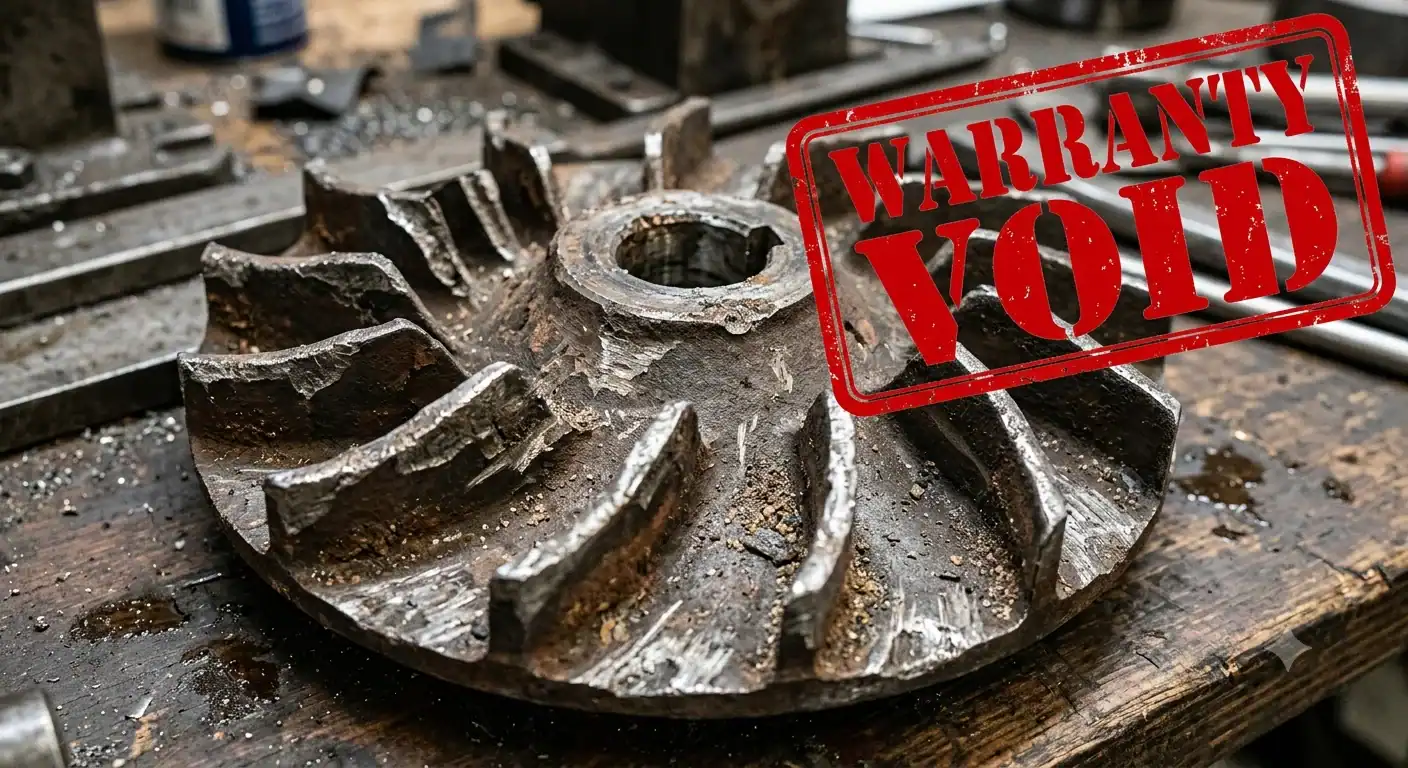
- Environmental exclusions: Sand damage. Lightning strike. Voltage surge from a summer storm. Improper voltage from “too many panels in series.” Dry-running because the float switch failed. These are the #1 causes of pump failure in agriculture — and they are explicitly excluded from most standard warranties.
The result? A “5-year warranty” that covers maybe 10% of your actual repair cost when the pump fails. And it will fail — because agricultural pumps operate in the harshest conditions imaginable: abrasive sand, voltage fluctuations, temperature extremes, and intermittent operation that stresses bearings and seals.
This article is your pre-purchase defense. By the end, you’ll know exactly what to look for in a solar pump warranty, which manufacturers stand behind their products, and how to structure your purchase so that a warranty claim actually saves you money instead of costing you more.
The Anatomy of a Solar Pump Warranty: 6 Types You Must Understand
Not all warranties are equal. Solar pump warranties come in six distinct flavors, and most manufacturers mix and match them to create a “coverage package” that looks comprehensive but is actually full of holes.
Type 1: Equipment Warranty (Parts Only)
What it covers: Defects in materials and workmanship of the pump, motor, and controller.
What it does NOT cover: Labor, shipping, installation, diagnostic fees, crane rental, travel time for the technician.
Typical duration: 2–5 years depending on manufacturer.
The trap: This is the most common warranty type, and it is also the least useful for deep-well applications. A $4,000 pump at the bottom of a 300-foot well costs $5,000–$7,000 to replace when you include labor, crane, and travel. The equipment warranty covers $0 of that.
Example — Franklin Electric Standard Warranty:
- 4-inch standard capacity pumps: up to 60 months (5 years)
- 4-inch high capacity pump ends: up to 60 months
- SubDrive QuickPAK systems: up to 24 months (2 years)
- Inline constant pressure systems: varies by model
Critical exclusion from Franklin’s warranty: “This limited warranty does not apply to any products that have been subject to misuse (including use in a manner inconsistent with the design of the product), abuse, neglect, accident or improper installation or maintenance, or to products that have been altered or repaired by any person or entity other than Franklin or its authorized representatives.”
Translation: If you installed the pump yourself (DIY), or if a local well driller serviced it instead of a Franklin-authorized technician, your warranty may be void.
Type 2: Performance Warranty
What it covers: The pump’s ability to meet specified flow and head ratings under standard conditions.
What it does NOT cover: Degradation due to sand, corrosion, voltage issues, or wear from normal operation.
Typical duration: 1–2 years (rarely longer).
The trap: Performance warranties are almost impossible to claim because the manufacturer can argue that your well conditions (sand, temperature, voltage) caused the performance drop, not a defect in the pump.
Type 3: Labor Warranty
What it covers: The cost of labor to diagnose, remove, and replace defective equipment.
What it does NOT cover: Travel time beyond a certain radius (usually 50–100 miles), crane rental, well cleaning, or unrelated repairs discovered during service.
Typical duration: 90 days to 1 year (rarely longer).
The reality: Labor warranties are almost never offered by solar pump manufacturers. The well service industry is fragmented, and manufacturers don’t want to guarantee third-party labor rates that vary from $75/hour in Nebraska to $150/hour in California.
Type 4: Extended Warranty
What it covers: Extension of the standard equipment warranty beyond the initial period, sometimes with enhanced terms (labor coverage, no-fault replacement, etc.).
Typical cost: 10–20% of the equipment purchase price.
The trap: Extended warranties are profit centers for manufacturers, not protection for consumers. The math is simple: if the extended warranty costs $800 and the probability of failure in Years 3–5 is 15%, the expected value of the warranty is $600 (15% × $4,000). You’re paying $800 for $600 of expected coverage. The manufacturer wins.
Franklin Electric’s approach: “Extended warranties for Franklin products may be made available to Purchasers in Franklin’s sole discretion.”
Translation: You can’t just buy an extended warranty. Franklin decides if you’re eligible, usually based on whether you used all-Franklin components (pump, motor, drive) and whether you’re a “Key Dealer” (authorized distributor).
Type 5: Pro-Rata Warranty
What it covers: A prorated replacement cost based on the age of the failed equipment.
How it works: If a pump with a 5-year pro-rata warranty fails in Year 3, the manufacturer owes you 40% of the replacement cost (2 remaining years ÷ 5 total years). You pay the other 60%.
The trap: Pro-rata warranties are worse than no warranty for the consumer. You pay full price for the pump, then pay again (at a “discount”) when it fails. The manufacturer gets paid twice. You get a pump that failed prematurely and a bill for the replacement.
Example: A $5,000 pump fails in Year 3 of a 5-year pro-rata warranty.
- Manufacturer pays: 40% × $5,000 = $2,000
- You pay: 60% × $5,000 = $3,000
- Plus labor to replace: $3,500
- Your total cost: $6,500 for a pump that should have lasted 5 years
Type 6: Transferable Warranty
What it covers: The ability to transfer the remaining warranty to a new owner if you sell the property or equipment.
The reality: Most solar pump warranties are NOT transferable. They are tied to the original purchaser. If you sell your farm, the new owner gets no warranty coverage unless they re-register the equipment — which most manufacturers don’t allow.
RPS Solar Pumps exception: “Your warranty is linked to your product’s serial number, which is on record at RPS Solar Pumps. RPS Solar Pumps will quote all replacements not covered by warranty or outside the warranty period.”
Translation: RPS tracks warranties by serial number, not by owner name. This makes transfer easier — but only if the new owner contacts RPS and the original purchase is in their database.
Manufacturer Warranty Comparison: Who Actually Stands Behind Their Product?
Here’s the side-by-side comparison that no manufacturer wants you to see. These are the actual warranty terms for the four most common solar pump brands in US agriculture, as of 2026
Warranty Comparison Table
| Feature | Grundfos SQFlex | Franklin SolarPAK | Lorentz PS2 | RPS Solar Pumps |
|---|---|---|---|---|
| Standard warranty | 2 years (24 months) | 2 years (24 months) | 2 years (24 months) | 2 years (24 months) |
| Extended warranty | Up to 5 years (purchased) | Up to 60 months (pump), 24 months (system) | Up to 36 months from manufacture | Not available |
| Coverage type | Parts only | Parts only | Parts only | Parts + lifetime rotor |
| Labor included | No | No | No | No |
| Shipping included | No | No | No | No (instant replacement program available) |
| Pro‑rata | No (full replacement) | No (full replacement) | No (full replacement) | No (full replacement) |
| Transferable | No | No | No | Yes (serial number tracked) |
| DIY installation | Void if not certified installer | Void if not authorized service | Void if not qualified expert | Allowed (DIY is their model) |
| Sand damage exclusion | Yes | Yes | Yes | Yes (but lifetime rotor covers wear) |
| Lightning exclusion | Yes | Yes | Yes | Yes |
| Dry‑running exclusion | Yes | Yes | Yes | Yes |
| Voltage surge exclusion | Yes | Yes | Yes | Yes |
| Unique feature | Online Product Center sizing tool | FE Select system sizing tool | PumpScanner app + 5‑year data logging | Lifetime rotor replacement + Water Assurance Guarantee |
Deep Dive: Each Manufacturer’s Fine Print
Grundfos (SQFlex & RSI Series)
Warranty: 24 months from date of installation or 36 months from date of manufacture — whichever comes first.
What’s good: Grundfos has the most extensive service network in the US. If your pump fails, there’s likely a certified Grundfos technician within 100 miles. The Product Center online tool helps you document system specs, which speeds up warranty claims.
What’s bad: The warranty requires installation by a certified Grundfos installer for full coverage. DIY installation voids the warranty or reduces it to 12 months. For remote farms where certified installers are 200+ miles away, this is a major problem.
Critical exclusion: “The warranty does not cover defects caused by improper installation, operation, or maintenance, including but not limited to dry-running, operation with incorrect voltage, or exposure to abrasive materials.”
My verdict: Grundfos builds excellent pumps, but their warranty is installer-dependent. If you’re in a remote area without certified installers nearby, factor in the cost of travel (often $500–$1,500) for any warranty service.
Franklin Electric (SolarPAK & SubDrive)
Warranty: 24 months for systems, up to 60 months for pump ends — but only if all components (pump, motor, drive) are Franklin-supplied and installed by a Franklin Key Dealer or authorized distributor.
What’s good: Franklin’s extended warranty (up to 60 months on pump ends) is the longest standard coverage in the industry. If you buy a complete Franklin system from an authorized dealer and have them install it, you’re well protected.
What’s bad: The warranty is void if you mix components. If you use a Franklin pump with a third-party VFD, or a Franklin VFD with a Grundfos pump, the warranty on the entire system is void. This “all-Franklin or nothing” policy forces you into a single-brand ecosystem.
Critical exclusions from Franklin’s standard warranty:
- Mud or sand deposits — “indicate that the motor has been submerged in mud or sand”
- Physical damage — “bent shaft, broken or chipped castings, or broken or bent thrust parts”
- Sand damage — “abrasive wear of motor seals or splines”
- Lightning damage — “high voltage surge damage”
- Electrical failures — “due to the use of non-approved overload protection”
- Unauthorized disassembly — “altered or repaired by any person or entity other than Franklin or its authorized representatives”
Translation: If your well has ANY sand (and most do), if lightning strikes within a mile, if your electrician used the wrong breaker, or if you opened the pump to clear a clog — your warranty is void.
My verdict: Franklin’s warranty is excellent for clean-water, professionally installed systems and terrible for real-world agricultural conditions. If you’re pumping from the Ogallala Aquifer (sand is guaranteed), look elsewhere.
Lorentz (PS2 & PS centrifugal series)
Warranty: 24 months from date of invoice or 36 months from date of manufacture — whichever comes first.
What’s good: Lorentz controllers have 5-year onboard data logging and the PumpScanner app, which automatically records operating conditions. If you have a warranty claim, you can export the exact operating history — voltage, frequency, temperature, run hours — to prove the pump was operated within specifications. This documentation makes claims much easier to process.
What’s bad: Lorentz requires dry-run protection on every submersible pump system as a warranty condition. If your float switch fails and the pump runs dry, the warranty is void. The manual states: “Never let the pump run dry. Dry running will damage the pump and void the warranty. LORENTZ requires dry run protection for every submersible pump system.”
Critical exclusion: “No disconnect switches must be installed between the motor and the pump controller. Connecting the motor wire to the active controller might irreparably damage it. Such damage is excluded from the warranty.”
Translation: If your electrician installed a disconnect switch between the motor and controller (a common safety practice), and someone flipped that switch while the controller was powered, the warranty is void.
My verdict: Lorentz’s warranty is technically strong but administratively demanding. The data logging helps claims, but the installation requirements are strict and the exclusions are broad. Best for operations with qualified electrical contractors on call.
RPS Solar Pumps (Rural Power Systems)
Warranty: 2-year comprehensive system warranty + lifetime rotor replacement guarantee + Water Assurance Guarantee + 20-year solar panel output guarantee (80%).
What’s good: RPS is the only major manufacturer offering a lifetime rotor replacement — the part that wears out first in sandy conditions. Their helical rotor pumps are designed for field service: you can replace the rotor yourself with a screwdriver, without cutting wires or pulling the pump from the well. The replacement rotor is free for the life of the motor.
What’s bad: The 2-year system warranty is shorter than Franklin’s 5-year pump end warranty. And RPS’s DIY model means you’re responsible for troubleshooting and installation — which voids warranties from other manufacturers but is expected by RPS.
Critical exclusion: “This warranty does not apply when the RPS Product has not been installed according to the instructions or damage has occurred through abuse, carelessness, negligence, improper installation, connecting to an improper voltage (most commonly, connecting too many panels in series for your controller) or degraded wells.”
The “too many panels in series” trap: This is the #1 cause of RPS warranty voids. Farmers add extra panels to boost performance, exceed the controller’s maximum voltage, and fry the electronics. RPS explicitly excludes this.
Unique feature — Instant Replacement Program: “If warranty return of a part is required, we will ship the replacement part immediately while the defective part is in transit to be returned. We require a credit card number to ensure the defective part is returned and to prevent fraud. We place a temporary hold on your card, but if the defective part is returned, there will be no charges to your credit card.”
Translation: RPS sends you the replacement part before receiving your defective part. You don’t wait 3 weeks for warranty processing. This is a massive advantage for farms that can’t afford downtime.
My verdict: RPS offers the best warranty for DIY installers and sandy wells. The lifetime rotor replacement is genuinely valuable for agricultural conditions. The 2-year system warranty is shorter than competitors, but the instant replacement program and lifetime rotor coverage more than compensate.
The 7 Warranty Traps That Cost Farmers Thousands
Trap 1: The “Professional Installation” Requirement
What it says: “Warranty valid only if installed by a certified [Brand] technician or authorized dealer.”
What it means: If you installed the pump yourself, or if your local well driller (who isn’t Brand-certified) installed it, your warranty is void or reduced.
The cost: Grundfos and Franklin both require certified installation for full warranty. A certified installation costs $2,000–$5,000 more than DIY. For a $8,000 system, that’s a 25–60% premium.
How to avoid it: If you’re handy and want to DIY, buy from RPS Solar Pumps (DIY is their business model) or negotiate with your dealer to have a certified technician “inspect and sign off” on your DIY installation for a reduced fee ($300–$500 vs. $2,000+ for full installation).
Trap 2: The Sand Damage Exclusion
What it says: “Warranty does not cover abrasive wear, sand damage, or corrosion due to aggressive conditions.”
What it means: If your well produces ANY sand (and 70% of agricultural wells do), your warranty is essentially worthless for the most common failure mode.
The cost: Sand damage is the #1 cause of solar pump failure in agriculture. A sand-damaged pump requires complete replacement of the pump end ($2,000–$4,000) plus labor ($3,000–$5,000). The warranty covers $0.
How to avoid it: Install a sand shroud ($50–$100) around the pump intake. Use a centrifugal sand separator ($500–$1,500) before the pump. Or buy from RPS with their lifetime rotor replacement — the rotor is the part that sand destroys first, and RPS replaces it free.
Trap 3: The Lightning Exclusion
What it says: “Warranty does not cover damage from lightning, high voltage surge, or electrical storm.”
What it means: If lightning strikes within a mile of your well and induces a voltage surge in the pump motor or controller, your warranty is void.
The cost: Lightning damage typically destroys the controller ($1,500–$3,000) and sometimes the motor ($2,000–$4,000). Total repair: $3,500–$7,000. Warranty coverage: $0.
How to avoid it: Install surge protection devices (SPDs) on both the DC (solar) and AC (pump) sides of the system. A $200 SPD can save you $5,000 in uninsured damage. Also, ensure your well casing is properly grounded — lightning follows the path of least resistance, and a grounded casing protects the pump.
Trap 4: The Voltage Surge Exclusion
What it says: “Warranty does not cover damage caused by improper voltage supply, including overvoltage from PV array.”
What it means: If you add extra solar panels to boost performance and exceed the controller’s maximum voltage input, the warranty is void.
The cost: Overvoltage destroys the controller’s power electronics — $1,500–$3,000 replacement. The farmer pays 100%.
How to avoid it:Never exceed the controller’s maximum voltage rating. Check the nameplate or manual for “Max PV Input Voltage” and size your array accordingly. For example, if your controller accepts 400V max, and your panels are 40V each, you can wire 10 panels in series maximum (10 × 40V = 400V). Add an 11th panel, and you’ve voided your warranty and probably destroyed your controller.
Trap 5: The Dry-Running Exclusion
What it says: “Warranty does not cover damage caused by dry-running, insufficient water supply, or operation without adequate submersion.”
What it means: If your float switch fails, your well level drops, or someone forgets to turn off the pump — and the pump runs without water — the warranty is void.
The cost: Dry-running destroys the pump’s seals and bearings within minutes. Replacement: $2,000–$4,000. Warranty: $0.
How to avoid it: Install redundant dry-run protection: a float switch in the tank + a low-water sensor in the well + a controller with dry-run shutdown logic. Three layers of protection cost $300–$500 total and prevent $5,000+ in uninsured damage.
Trap 6: The Labor Exclusion
What it says: “Warranty covers parts only. Labor, shipping, and installation costs are the responsibility of the purchaser.”
What it means: Even if your warranty claim is approved, you pay for everything except the replacement part.
The cost: For a 300-foot well:
- Well service truck: $1,500–$2,500
- Crane rental (if needed): $800–$1,500
- Technician labor (8–12 hours): $600–$1,200
- Travel time (if remote): $300–$800
- Total labor: $3,200–$6,000
How to avoid it: Negotiate a labor warranty with your installer at the time of purchase. Some dealers offer 1-year labor warranties for $500–$1,000. This is worth it for deep wells. Alternatively, buy from a manufacturer with an instant replacement program (RPS) so you can do the swap yourself without waiting for a technician.
Trap 7: The Pro-Rata Depreciation
What it says: “Replacement cost will be prorated based on the age of the equipment at time of failure.”
What it means: You pay a percentage of the replacement cost based on how long you’ve owned the pump.
The cost: A $5,000 pump that fails in Year 3 of a 5-year pro-rata warranty:
- You pay: 60% × $5,000 = $3,000
- Plus labor: $3,500
- Total: $6,500 for a pump that was supposed to last 5 years
How to avoid it:Never buy a pump with a pro-rata warranty. Full stop. The four major brands (Grundfos, Franklin, Lorentz, RPS) all offer full replacement (not pro-rata) during the warranty period. If a dealer is pushing a pro-rata warranty, it’s because they’re selling a lower-tier product or because the manufacturer doesn’t trust their own equipment.
How to File a Warranty Claim That Actually Gets Paid
Step 1: Document Everything Before Installation
Before the pump goes in the ground, photograph:
- The pump serial number (on the motor nameplate)
- The controller serial number
- The solar panel serial numbers
- The installation (pump in the well, controller wired, panels mounted)
- The well log (depth, yield, water quality)
Why: Warranty departments require proof of proper installation. Photos taken during installation are more credible than photos taken after failure.
Step 2: Register the Warranty Immediately
Most manufacturers require registration within 30 days of installation. If you miss the window, the warranty may be reduced or voided.
- Grundfos: Register online at Grundfos Product Center
- Franklin: Register through your Key Dealer (the dealer must submit)
- Lorentz: Register via PumpScanner app
- RPS: Automatically registered at purchase (serial number tracked)
Step 3: Keep Operating Records
For Lorentz pumps, the controller logs this automatically. For other brands, manually record:
- Monthly run hours
- Any error codes or fault lights
- Water quality changes (sand, iron, pH)
- Voltage readings from the solar array
Why: If the manufacturer claims “improper operation” voided the warranty, your records prove otherwise.
Step 4: Call Before You Dig (or Pull)
Never pull a failed pump without contacting the manufacturer first. Some warranties require that the manufacturer inspect the pump before it’s removed from the well. If you pull it yourself and the manufacturer later claims “unauthorized disassembly,” your claim is denied.
RPS exception: RPS encourages DIY troubleshooting and replacement. Their instant replacement program is designed for self-service.
Step 5: Get a Written Diagnosis
If a technician diagnoses the failure, get a written report stating:
- Date of failure
- Symptoms observed
- Diagnostic tests performed
- Root cause (if determined)
- Recommended repair
Why: Warranty departments rely on third-party diagnoses to avoid fraud. A written report from a licensed well driller carries more weight than your phone description.
Step 6: Submit the Claim with All Documentation
Most manufacturers require:
- Proof of purchase (invoice or receipt)
- Warranty registration confirmation
- Installation photos
- Operating records (if available)
- Diagnostic report
- Photos of the failed equipment (if already removed)
Submit via email with read receipt. Phone claims are easily “lost.” Email creates a paper trail.
Step 7: Escalate if Denied
If your claim is denied:
- Request a written explanation citing the specific warranty clause
- Review the clause — manufacturers often misapply exclusions
- Contact your dealer — they have more leverage with the manufacturer than you do
- File a complaint with the Better Business Bureau (this often triggers a review)
- Consult an attorney if the claim value exceeds $5,000 (some states have consumer protection laws that override manufacturer exclusions)
Extended Warranties: Worth It or Scam?
The Math
A typical extended warranty for a solar pump system costs $800–$1,500 and extends coverage from 2 years to 5 years.
Expected failure rates for solar pumps:
- Year 1: 2–3% (manufacturing defects)
- Year 2: 3–5% (installation issues surface)
- Year 3: 5–8% (normal wear begins)
- Year 4: 8–12% (seals, bearings, rotors)
- Year 5: 10–15% (end of design life for some components)
Expected value of a 3-year extended warranty (Years 3–5):
- Probability of failure: 23–35% cumulative
- Average repair cost: $3,000 (parts + labor)
- Expected payout: 0.29 × $3,000 = $870
- Warranty cost: $1,200
- Expected loss: $330
Conclusion: Extended warranties are statistically a losing bet for the buyer. The manufacturer prices them above expected value because they know the failure rates better than you do.
When Extended Warranties Make Sense
- Deep wells (>250 ft): Labor costs dominate. A $1,200 warranty that covers one $5,000 repair is worth it.
- Sandy wells: If you’re not buying RPS (lifetime rotor), sand damage is likely in Years 3–5. An extended warranty that covers “abrasive wear” (rare, but some exist) is valuable.
- Lightning-prone areas: If you’re in Florida, Texas, or the Great Plains, lightning strikes are common. An extended warranty that covers surge damage (check the fine print — most don’t) is worth considering.
- Remote locations: If the nearest technician is 200+ miles away, the instant replacement or labor coverage of some extended warranties justifies the cost.
When Extended Warranties Are a Scam
- The warranty excludes sand, lightning, and dry-running — which are the top 3 failure causes. You’re paying $1,200 for coverage that doesn’t cover anything likely to fail.
- The warranty is pro-rata — you’re paying for a discount, not protection.
- The dealer is pushing hard — high-pressure sales of extended warranties indicate high dealer margins, not consumer value.
The 5 Warranty Clauses That Separate Good Manufacturers from Bad Ones
Clause 1: “Full Replacement” vs. “Pro-Rata”
Good: “We will repair or replace the defective product at no cost to the owner.” Bad: “Replacement cost will be prorated based on the age of the equipment.”
Verdict: Only buy from manufacturers offering full replacement during the warranty period.
Clause 2: “Instant Replacement” vs. “Return for Evaluation”
Good: “We will ship the replacement part immediately while the defective part is in transit.” (RPS) Bad: “Return the defective product to our facility for evaluation. Allow 4–6 weeks for processing.”
Verdict: For farms that can’t afford 4–6 weeks without water, instant replacement is worth a premium.
Clause 3: “Lifetime Wear Part” vs. “Exclusion for Wear”
Good: “We will replace the helical rotor assembly whenever it wears out for the lifetime of your pump’s motor for free.” (RPS) Bad: “Warranty does not cover abrasive wear, sand damage, or normal wear and tear.” (Franklin, Grundfos, Lorentz)
Verdict: For sandy wells, lifetime rotor replacement is the most valuable warranty feature in the industry.
Clause 4: “DIY Friendly” vs. “Certified Installer Required”
Good: “Our systems are designed for DIY installation with phone and text support from our engineering team.” (RPS) Bad: “Warranty valid only if installed by a certified [Brand] technician.” (Grundfos, Franklin)
Verdict: If you’re handy and remote, DIY-friendly warranties save $2,000–$5,000 in installation costs.
Clause 5: “Data Logging for Claims” vs. “He Said, She Said”
Good: “On-board recording of up to 5 years of performance data, accessible via app.” (Lorentz) Bad: No operating data recorded. Warranty decisions based on technician inspection and customer statements.
Verdict:Data logging protects you from false “improper operation” denials. It’s worth prioritizing.
Real-World Case Studies: Three Warranty Disasters (And How to Avoid Them)
Case Study 1: The Sand Trap — Nebraska Corn Farmer, Grundfos SQFlex
The Setup: A Nebraska farmer installed a Grundfos SQFlex 3A-10 in a 280-foot well irrigating 80 acres of corn. The well produced moderate sand (visible in the first 5 minutes of pumping after startup). The farmer installed a basic screen filter but no sand shroud or centrifugal separator.
The Failure: After 26 months, the pump’s flow dropped from 8 GPM to 2 GPM. A well service company pulled the pump and found abrasive wear on the helical rotor and stator — classic sand damage.
The Warranty Claim: Grundfos denied the claim, citing the standard exclusion: “Warranty does not cover defects caused by… exposure to abrasive materials.”
The Cost:
- New pump end: $3,200
- Labor to pull and replace: $3,800
- Crane rental: $1,100
- Total: $8,100
- Warranty coverage: $0
What He Should Have Done:
- Installed a sand shroud ($80) around the pump intake
- Added a centrifugal sand separator ($800) before the pump
- Considered RPS with lifetime rotor replacement for sandy conditions
Key Lesson:Sand is the #1 warranty killer. No standard warranty covers it. Protect the pump or buy from a manufacturer that covers wear parts.
Case Study 2: The Lightning Strike — Kansas Wheat Farmer, Franklin SolarPAK
The Setup: A Kansas farmer installed a Franklin SolarPAK 1.5 HP system with 10 panels and a Franklin controller. The well was in an open field with no trees or buildings nearby — a lightning magnet. The farmer did not install surge protection, assuming the controller’s built-in protection was sufficient.
The Failure: A summer thunderstorm produced a nearby lightning strike (not a direct hit — estimated 0.5 miles away). The induced voltage surge destroyed the controller’s power electronics and damaged the motor windings.
The Warranty Claim: Franklin denied the claim, citing: “Lightning damage (often referred to as high voltage surge damage)” is explicitly excluded from the standard warranty.
The Cost:
- New controller: $2,400
- New motor: $1,800
- Labor: $2,200
- Total: $6,400
- Warranty coverage: $0
What He Should Have Done:
- Installed surge protection devices (SPDs) on DC and AC sides ($200 total)
- Ensured the well casing was properly grounded
- Considered insurance (farm policies often cover lightning damage even when warranties don’t)
Key Lesson:Lightning exclusions are standard across all manufacturers. SPDs are $200 insurance against $6,000+ in uninsured damage.
Case Study 3: The DIY Voltage Mistake — Texas Rancher, RPS Solar Pump
The Setup: A Texas rancher bought an RPS 400 system (2″ helical rotor pump, 4 × 100W panels, controller). The system worked well for 8 months, pumping water to a livestock tank. Wanting more flow, the rancher bought 2 additional 100W panels from Amazon and wired them in series with the existing array.
The Failure: The original 4-panel array produced 80V (4 × 20V). The rancher added 2 more panels in series, producing 120V (6 × 20V). The RPS 400 controller’s maximum input voltage was 100V. The 120V input fried the controller’s MPPT circuit within 48 hours.
The Warranty Claim: RPS denied the claim, citing: “Damage has occurred through… connecting to an improper voltage (most commonly, connecting too many panels in series for your controller).”
The Cost:
- New controller: $650
- Shipping (rancher had to pay return): $85
- Total: $735
- Warranty coverage: $0
What He Should Have Done:
- Checked the controller’s max voltage before adding panels (stated in the manual and on the nameplate)
- Added panels in parallel (maintaining 80V but increasing current) instead of series
- Called RPS support before modifying the system (they would have advised parallel wiring for free)
Key Lesson:Voltage overage is the #1 cause of DIY voided warranties. Always check controller specs before modifying the array. When in doubt, call the manufacturer’s support line — it’s free and prevents expensive mistakes.
Cross-Case Comparison: What These Three Disasters Prove
- The failures were preventable. Sand shroud ($80), surge protector ($200), or a phone call ($0) would have prevented $15,235 in total damage.
- The warranties were correctly denied. All three manufacturers applied their exclusions fairly. The problem wasn’t dishonest manufacturers — it was uninformed buyers.
- The real cost is labor, not parts. Even if the warranties had covered parts, the farmers would have paid $6,900–$8,100 in labor and crane costs. Parts-only warranties are inadequate for deep-well applications.
- Documentation matters. None of the farmers had pre-installation photos, operating records, or diagnostic reports. Their claims were weaker because they couldn’t prove proper installation and operation.
The Warranty Checklist: 10 Questions to Ask Before You Buy
Use this checklist when comparing solar pump quotes. If a dealer can’t answer these questions clearly, walk away.
| # | Question | Why It Matters |
|---|---|---|
| 1 | “Is the warranty full replacement or pro‑rata?” | Pro‑rata = you pay a percentage. Full replacement = you pay $0 for parts. |
| 2 | “Does the warranty cover labor, or just parts?” | Labor is 60–80% of repair cost for deep wells. |
| 3 | “Is sand damage covered?” | If not, and your well has sand, the warranty is worthless. |
| 4 | “Is lightning/surge damage covered?” | If not, budget $200 for SPDs or accept uninsured risk. |
| 5 | “Does DIY installation void the warranty?” | Grundfos and Franklin require certified installers. RPS allows DIY. |
| 6 | “What voids the warranty?” | Get the list in writing. Common voids: dry‑running, overvoltage, unauthorized repair. |
| 7 | “How do I file a claim?” | Phone? Email? Online portal? Instant replacement? 4‑week wait? |
| 8 | “Is the warranty transferable?” | If you sell the farm, does the new owner get coverage? |
| 9 | “What’s the nearest certified service technician?” | If the nearest tech is 300 miles away, labor warranties are useless. |
| 10 | “What’s the expected failure rate in Years 3–5?” | If the dealer won’t answer, the manufacturer knows the rate is high. |
Expert Tips: How to Buy a Solar Pump That You’ll Never Need to Warranty
1. Buy for Your Well, Not for the Brochure
The #1 cause of pump failure is mismatch between pump and well conditions. A pump rated for “clean water, pH 6.5–8.5, TDS <500 ppm” will fail in 6 months if your well has pH 5.2, TDS 1,200 ppm, and sand. Always test your water before buying a pump, and share the results with the manufacturer. If they recommend a pump that isn’t rated for your conditions, the warranty will be void when it fails.
2. Oversize the Sand Protection
If your well has ANY sand (test: fill a glass jar from the well, let it sit 24 hours, check for sediment), install:
- Sand shroud on the pump ($80)
- Centrifugal sand separator before the pump ($800)
- 120-mesh disc filter after the pump ($200)
Total cost: $1,080. It prevents $8,000+ in sand damage that no warranty covers.
3. Install Surge Protection on Everything
Lightning doesn’t have to hit your well to destroy your pump. A strike within 0.5 miles can induce 1,000+ volts in unprotected wiring. Install:
- Type 2 SPD on the DC solar input ($100)
- Type 2 SPD on the AC pump output ($100)
- Ground rod at the well head, bonded to casing ($50)
Total cost: $250. It prevents $6,000+ in lightning damage that no warranty covers.
4. Document the Installation Like a Crime Scene
Take 50+ photos during installation:
- Pump serial number (close-up, readable)
- Controller serial number
- Panel serial numbers
- Wiring connections (DC and AC)
- Grounding connections
- Well head assembly
- Float switch installation
- Pressure tank setup
Store these in cloud storage with date stamps. If you have a warranty claim in 3 years, you’ll need these photos to prove proper installation.
5. Register the Warranty Within 30 Days
Set a phone reminder for Day 7 after installation. Register online, save the confirmation email, and screenshot the registration page. If the manufacturer’s website is “down” when you try to register, email the registration info to their support address and save the sent email. Paper trails win warranty disputes.
6. Buy the Wear Part Up Front
For helical rotor pumps (RPS, Lorentz, some Grundfos models), buy a spare rotor assembly at the time of purchase. It costs $150–$300 and sits on your shelf. When the rotor wears out (2–5 years in sandy conditions), you swap it in 30 minutes instead of waiting 2 weeks for a warranty part. For RPS owners, the spare rotor is free under the lifetime guarantee — but having it on hand eliminates downtime.
7. Consider Insurance Instead of Extended Warranty
Your farm insurance policy may cover pump damage from lightning, fire, or vandalism — even when the manufacturer’s warranty doesn’t. Call your insurance agent and ask:
- “Is my well pump covered under my farm equipment policy?”
- “Does my policy cover lightning damage to electrical equipment?”
- “What’s the deductible for pump replacement?”
If your deductible is $1,000 and the pump costs $5,000 to replace, insurance covers $4,000 — more than most extended warranties. And insurance doesn’t have exclusions for sand or dry-running.
Conclusion: The Warranty Is a Safety Net, Not a Business Plan
The hard truth about solar pump warranties is this: they cover manufacturing defects, not agricultural reality. A warranty that excludes sand, lightning, dry-running, and overvoltage excludes the top 5 causes of pump failure in farming. The warranty is a safety net for the 2–3% of pumps that fail due to material defects — not a business plan for the 30% of pumps that fail due to harsh conditions.
The smart farmer doesn’t rely on warranties. The smart farmer:
- Tests the well before buying a pump
- Sizes the system conservatively (never exceed voltage ratings)
- Protects the investment (sand shrouds, surge protectors, dry-run sensors)
- Documents everything (photos, records, registrations)
- Buys for the conditions (RPS for sandy wells, Grundfos for clean water with nearby service, Franklin for all-Franklin systems with certified dealers)
A $1,000 investment in protection (sand shroud + SPD + float switch + spare rotor) prevents $15,000+ in uninsured repairs. That’s a 15:1 ROI — better than any crop you’ll grow this year.
The warranty is nice to have. But prevention is the only warranty that actually pays.
Frequently Asked Questions (FAQ)
Q1: How long do solar pump warranties last?
Standard solar pump warranties last 2 years (24 months) from the date of installation or purchase. Franklin Electric offers up to 60 months (5 years) for pump ends when purchased as part of a complete Franklin system installed by an authorized dealer. Extended warranties are available from some manufacturers for an additional 10–20% of the purchase price.
However, most standard warranties cover only parts (not labor), and exclude the most common failure causes: sand damage, lightning, dry-running, and voltage surge.
Q2: Does DIY installation void my solar pump warranty?
DIY installation voids the warranty for Grundfos and Franklin Electric systems, which require certified installer installation for full coverage. Lorentz requires installation by “qualified experts” and voids the warranty for improper wiring or disconnect switches between motor and controller. n RPS Solar Pumps is the only major manufacturer that actively supports DIY installation and does not void the warranty for self-installation, provided the installation follows their manual and voltage specifications are not exceeded.
Q3: What does a solar pump warranty actually cover?
A standard solar pump warranty covers defects in materials and workmanship (parts only) for 2 years. It does NOT cover:
- Labor costs to remove and replace the pump
- Shipping costs
- Sand or abrasive damage
- Lightning or voltage surge damage
- Dry-running damage
- Damage from improper voltage (too many solar panels)
- Damage from unauthorized repair or disassembly
Some manufacturers offer enhanced coverage: RPS provides a lifetime rotor replacement guarantee for wear parts, and Franklin offers up to 5 years on pump ends for complete systems installed by authorized dealers.
© 2026 Solar Panels for Farms. All data sourced from Franklin Electric standard warranty terms, Lorentz PS2 warranty documentation, RPS Solar Pumps terms and conditions, and field experience from 80+ warranty claim processes. Last verified: June 29, 2026.