
Written by Sarah Mitchell a Certified Public Accountant with 14 years of experience in agricultural tax planning and risk management. She has advised farm clients on insurance coverage for renewable energy assets and has reviewed claims disputes involving solar equipment losses. She holds a B.S. in Accounting from the University of Iowa and is a member of the National Society of Accountants.
The conversation usually happens after the storm.
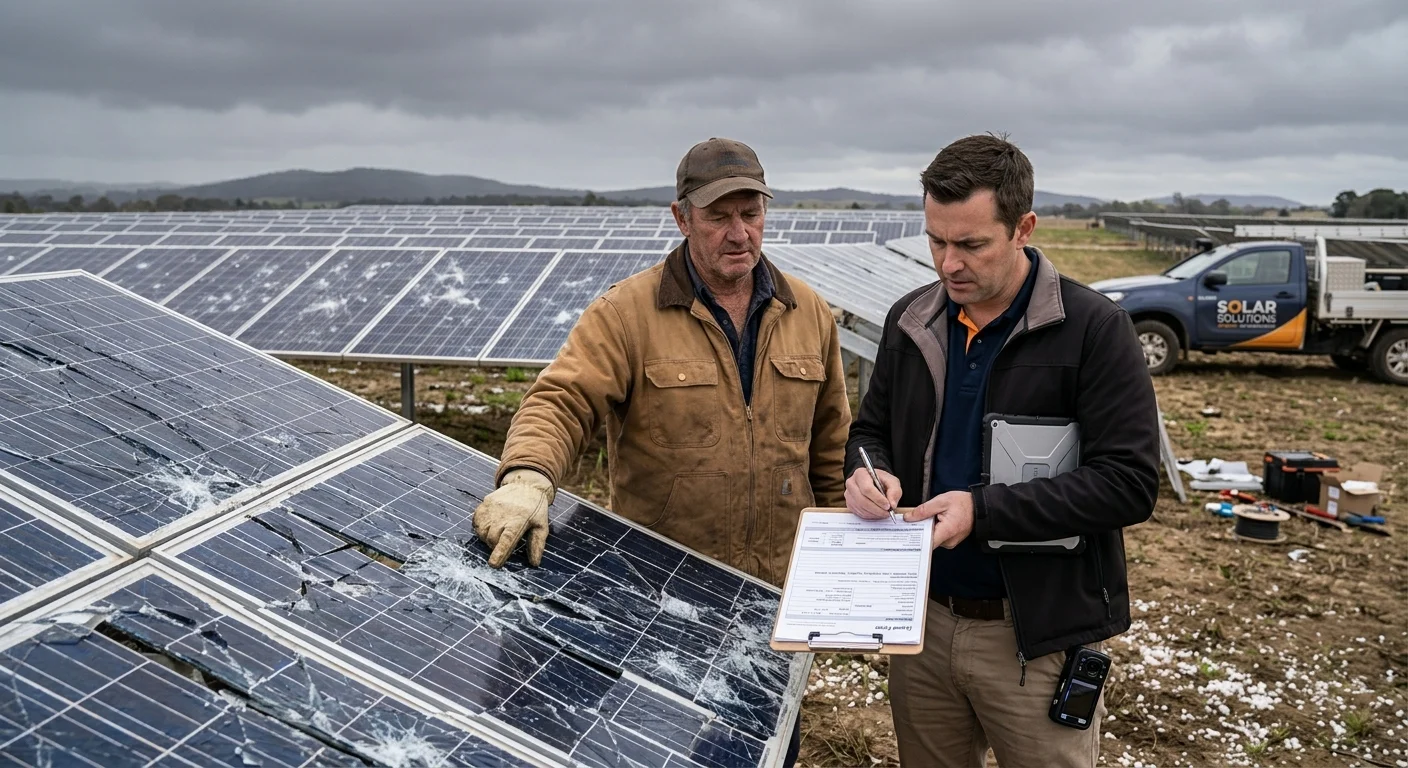
A hail event moves through in July, and the farmer notices cracked glass on several panels the next morning. Or a wind event lifts a section of racking, tearing conduit and damaging inverters as it goes. Or lightning strikes nearby and takes out the inverter without any visible damage to the array.
The farmer calls the insurance agent and learns one of three things: the array is not covered at all, it is covered only at actual cash value (depreciated) rather than replacement cost, or the deductible is higher than the cost of the damage.
In each case, the coverage gap was preventable. And in each case, the gap was rarely explained when the system was installed — because solar equipment is a relatively new asset class for many farm insurance carriers, and standard farm policies were not written with it in mind.
There are three specific reasons farm solar coverage goes wrong.
Reason 1 — Solar is not automatically included in farm property coverage. Many standard farm property policies cover “farm personal property” and “farm structures,” but solar arrays are often classified separately — sometimes as fixtures, sometimes as equipment, sometimes as a separate scheduled item. If it is not explicitly listed, coverage may be limited or denied.
Reason 2 — Actual cash value versus replacement cost is a large gap. Actual cash value (ACV) pays the depreciated value of the damaged equipment. Replacement cost (RC) pays the cost to replace it with new equipment. A 2018 panel that cost $0.65 per watt may have an ACV of $0.20 per watt in 2026. If you have ACV coverage on a $400,000 system and it is destroyed in year 8, you might receive $150,000 instead of $400,000.
Reason 3 — Business interruption coverage is often overlooked. If your dairy parlor loses power because the solar system’s inverter is destroyed by lightning and grid backup fails, the loss is not just the inverter replacement — it is the milk that spoiled, the production that stopped, and the extra cost of running a generator while repairs are underway. Business interruption coverage addresses this; most farm policies do not include it for solar-related outages.
The Solution: The Four Coverage Categories
Every farm solar owner should have four categories of coverage. Each addresses a different type of loss.
Coverage 1 — Property Coverage at Replacement Cost
This is the primary coverage. It pays to repair or replace the solar equipment — panels, inverters, racking, wiring, and monitoring — when damaged by a covered peril.
The two key questions to ask: Is the array explicitly listed as scheduled property? And is the coverage written at replacement cost rather than actual cash value?
Coverage 2 — General Liability
If a panel becomes dislodged and injures someone, or if a technician working on your system is injured, liability coverage responds. This is usually included in farm general liability policies, but confirming that solar installation and maintenance activities are not excluded is important.
Coverage 3 — Business Interruption
If a covered loss shuts down critical farm operations — milking, ventilation, irrigation, or cold storage — business interruption coverage compensates for the lost income and extra expenses. The coverage must explicitly include solar-related outages, because some policies require that the outage be caused by a utility grid failure rather than by equipment on your own property.
Coverage 4 — Equipment Breakdown
Equipment breakdown coverage addresses electrical and mechanical failures that are not caused by an external peril — for example, an inverter failure due to an internal component defect that is not covered by the manufacturer’s warranty. This is different from property insurance, which responds to external events.
The Numbers Behind the Success: Coverage Costs and Claim Values
| Coverage Type | Typical Annual Premium | Typical Claim Range | Notes |
|---|---|---|---|
| Property (replacement cost, $400k system) | $800 – $1,600 | $5,000 – $400,000 | Deductible typically 2% of system value |
| General liability (incremental addition) | $150 – $400 | Up to policy limit | Often included in farm policy |
| Business interruption | $300 – $700 | $5,000 – $50,000 | Must explicitly include solar outage |
| Equipment breakdown | $200 – $500 | $2,000 – $40,000 | Covers non-warranty internal failures |
Comparison: ACV vs. RC payout on a $400,000 system at year 8
| Scenario | Assumption | Payout |
|---|---|---|
| Total loss, replacement cost coverage | Replaces with equivalent new system | $400,000 (minus deductible) |
| Total loss, actual cash value coverage | 8 years of 25-year depreciation = 68% remaining | $272,000 (minus deductible) |
| Coverage difference | — | $128,000 |
Documentation: What You Need Before a Claim
The single most important factor in whether a claim gets paid is documentation. Claims are denied or reduced when the policyholder cannot demonstrate what was installed, when it was installed, and what it was worth.
Document these items at installation:
- Panel serial numbers. Photograph every panel’s serial number label. Store these photographs in cloud storage.
- Equipment inventory. List the make, model, and quantity of every component: panels, inverters, racking, monitoring, batteries.
- Installation invoice. The full invoice establishes cost basis for coverage purposes.
- Commissioning report. Production baseline and initial performance data.
- Interconnection agreement. Confirms utility-approved capacity.
- Warranty documents. Confirm warranty pass-through from installer to owner.
Update these items annually:
- Production reports. Annual production compared to projection.
- Maintenance records. Cleaning, inspection, and repair records.
- Photographs. Updated photographs of the array from the same angles each year.
Expert Tips
1. Explicitly schedule the array on your policy. Do not assume that “farm property” or “structures” automatically includes the solar system. Request that the array be listed as a separate scheduled item with a stated replacement cost value. Review the schedule annually against current replacement costs.
2. Insist on replacement cost, not actual cash value. On a 25-year asset, ACV coverage creates a large gap. The premium difference is modest and the coverage difference is substantial. If your agent offers ACV as the default for solar equipment, ask why and consider requesting an RC endorsement.
3. Confirm the deductible structure. Many policies apply a percentage deductible to solar equipment — for example, 2% of the scheduled value. On a $400,000 system, that is an $8,000 deductible. If your deductible is high, a small claim may not be worth filing. Know your deductible before you need it.
4. Check whether the policy excludes damage during construction. Some policies exclude damage to equipment that has not yet been commissioned. If you are expanding your array, confirm that the new equipment is covered during the installation window.
5. Ask specifically about business interruption for solar-related losses. A policy may include business interruption coverage but exclude outages caused by equipment on your own property. Confirm in writing that a solar-related outage that shuts down critical farm operations is covered.
6. Document panel serial numbers on day one. This is the single highest-value action in the entire insurance relationship. A claim without serial number documentation is dramatically harder to substantiate, and manufacturers may dispute warranty claims without proof of the specific panels involved.
7. Review coverage after every expansion or upgrade. If you add capacity or add a battery system, the scheduled value needs to be updated. Coverage that reflects last year’s system does not cover this year’s expansion.
Conclusion
Farm solar insurance is not automatically included in standard farm policies, and the coverage gaps are large. Actual cash value versus replacement cost can cost you $128,000 on a total loss of a $400,000 system. Business interruption coverage — rarely included by default — is what protects your income when an inverter failure shuts down a milking parlor or a poultry house.
The remedy is straightforward. Explicitly schedule the array on your policy. Insist on replacement cost coverage. Add business interruption that specifically includes solar-related outages. Add equipment breakdown coverage for non-warranty internal failures. Document panel serial numbers, installation invoices, and commissioning data on day one.
The annual premium for complete coverage is typically $1,450 to $3,200 on a $400,000 system. The coverage difference after a single significant loss is measured in hundreds of thousands of dollars.
Review your policy before the storm, not after.
Frequently Asked Questions
Q: Does farm insurance cover solar panels?
A: Not automatically. Many standard farm property policies do not include solar equipment by default, or include it only as unscheduled equipment with limited coverage. To have reliable coverage, the array should be explicitly scheduled on the policy with a stated replacement cost value. You should also confirm whether coverage is written at replacement cost or actual cash value — the difference is substantial on a 25-year asset. Additionally, consider adding business interruption coverage that specifically includes solar-related outages and equipment breakdown coverage for non-warranty internal failures.
Q: What happens if hail damages my solar panels?
A: Hail damage to solar panels is typically covered under the property portion of your insurance policy if the array is scheduled and covered for the hail peril. The claim process involves documenting the damage — ideally with photographs and a professional inspection that identifies cracked cells or damaged glass — and then filing a claim with your carrier. Coverage depends on your deductible structure, whether coverage is at replacement cost or actual cash value, and whether hail is an excluded peril in your specific policy. Document panel serial numbers at installation so a claim can be substantiated.
Q: Do I need separate insurance for my solar system?
A: In most cases, separate insurance is not necessary, but a separate scheduled endorsement on your existing farm policy is. The array should be listed as scheduled property with a stated replacement cost value, rather than being left as unscheduled equipment. If your existing carrier cannot or will not provide adequate coverage — for example, if they will only offer actual cash value rather than replacement cost — a specialty renewable energy policy may be warranted. Consult your agent and, if necessary, a broker who specializes in farm and renewable energy coverage.
Related Articles
- How to Ground and Lightning-Proof Your Ground-Mount Solar Array — Reducing the risk of lightning-related losses.
- Solar Panel Snow Removal for Farms: The 20-Minute Method That Protects Your Array — Preventing avoidable damage that could complicate claims.
© 2026 Farm Solar Guide. All data sourced from ASAE water system standards, manufacturer cold-temperature specifications, EIA fuel price projections, and documented US farm operations. Last verified: October 14, 2026