
Written by Dr. Robert Kowalski a Ph.D. in Agricultural and Biological Engineering from Penn State University and has 18 years of experience in grain handling and drying systems. He has designed solar-integrated drying systems for corn, wheat, and soybean operations across the Midwest. He is a licensed Professional Engineer and a member of the American Society of Agricultural and Biological Engineers.
The Problem
Grain drying is the single largest energy expense on many grain farms. For a 1,000-acre corn operation, propane or natural gas drying costs can exceed **$40,000 per year** at 2026 fuel prices. Propane at $2.50 per gallon and fuel oil at $4.00 per gallon have made drying brutally expensive.
The problem is not just cost. It is timing. Harvest happens in a narrow window. If your dryer cannot keep up, grain spoils in the field or goes into storage too wet. If your fuel supplier cannot deliver during peak demand, you are stuck. And every year, the fuel bill goes up.
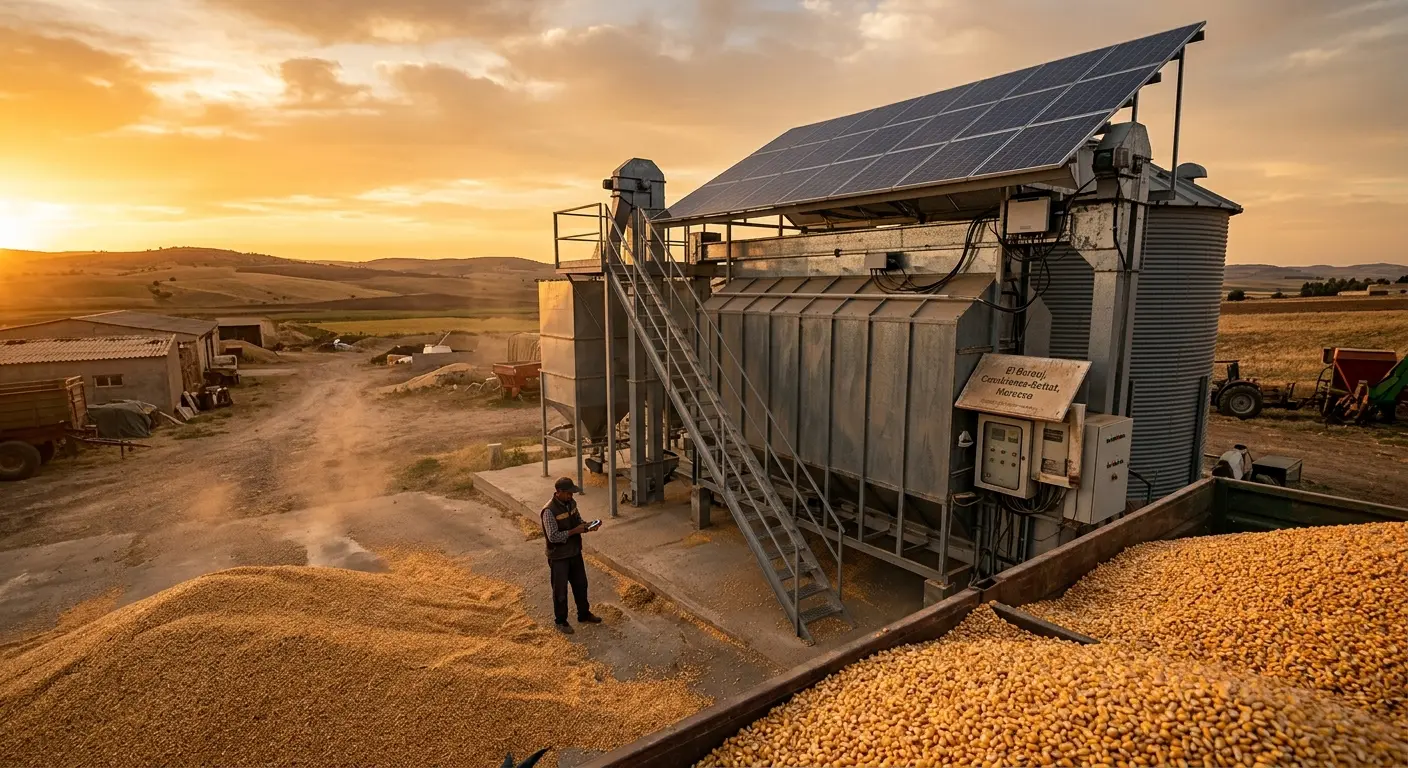
Solar grain drying is not a new idea. But the 2026 data now shows that a solar PV system with a properly sized backup heat source can reduce drying energy costs by 40% to 60% — without risking a single bushel of grain.
The Solution: PV + Backup Heat, Not 100% Solar
The biggest mistake farmers make with solar grain drying is trying to design a 100% solar system. That is not practical. Grain drying requires high temperatures and high airflow, often running 24 hours a day during harvest. A solar-only system would require an impossibly large array and battery bank.
The correct approach is a hybrid system:
- Solar PV array sized to offset 50% to 70% of the dryer’s annual electricity consumption
- Existing propane or natural gas burner retained as backup
- Optional battery storage for load shifting, if your utility offers time-of-use rates
A 2026 study published in Sage Sphere Multidisciplinary Studies designed a solar-powered grain drying system with lithium battery storage that reduced drying time to 4 to 6 hours, achieved optimal final moisture of 8% to 9%, and delivered a net present value of $21,824 with an internal rate of return of 21.6%.
Another review of solar drying systems found payback periods ranging from 0.6 to 3.7 years, with over 80% savings in operating costs.
The Comparison: Propane vs. Solar Hybrid Grain Drying
| Parameter | Propane Dryer (Baseline) | Solar PV + Propane Backup |
|---|---|---|
| System cost | $0 (existing) | $180,000 – $250,000 (100 kW) |
| Annual fuel cost | $40,000 | $16,000 – $24,000 |
| Annual electricity cost | $3,000 | $1,000 – $1,500 |
| Annual maintenance | $2,500 | $3,500 |
| Total annual operating cost | $45,500 | $20,500 – $29,000 |
| Annual savings | — | $16,500 – $25,000 |
| Simple payback (after 30% ITC) | — | 5.0 – 7.5 years |
| 25‑year cumulative savings | — | $412,500 – $625,000 |
The Numbers Behind the Success: 100 kW Solar System for a 1,000-Acre Corn Farm
System Assumptions:
- Dryer size: 1,000 bushels per hour
- Annual drying volume: 250,000 bushels
- Propane consumption: 16,000 gallons per year at $2.50/gallon
- Annual propane cost: $40,000
- Solar system size: 100 kW
- Installed cost: $1.60 per watt
- Gross system cost: $160,000
- ITC (30%): -$48,000
- Net system cost: $112,000
Annual Cash Flow After Solar Installation:
| Item | Without Solar | With Solar Hybrid |
|---|---|---|
| Propane cost | $40,000 | $20,000 |
| Electricity cost | $3,000 | $1,200 |
| Maintenance | $2,500 | $3,500 |
| Total operating cost | $45,500 | $24,700 |
| Annual savings | — | $20,800 |
Payback Calculation:
- Net system cost: $112,000
- Annual savings: $20,800
- Simple payback: 5.4 years
25-Year Cumulative Savings:
| Year | Annual Savings | Cumulative |
|---|---|---|
| 1 | $20,800 | $20,800 |
| 5 | $20,800 | $104,000 |
| 10 | $20,800 | $208,000 |
| 25 | $20,800 | $520,000 |
After the 5.4-year payback, the system generates $20,800 per year** in savings for the remaining 19.6 years — a total 25-year net benefit of **$520,000.
Expert Tips
1. Size the solar array for the dryer’s electrical load, not the farm’s total load. Grain dryers have a massive electrical demand — often 50 to 100 kW for a large continuous-flow dryer. If your solar array is undersized, you will not offset the dryer’s consumption during the critical harvest window. Model the dryer’s hourly load profile before sizing the array.
2. Keep the propane burner — do not remove it. A 100% solar dryer is not practical. The backup burner ensures you can dry grain even during cloudy weather or at night. The hybrid approach gives you the savings of solar without the risk of spoilage.
3. Consider battery storage for time-of-use rate arbitrage. If your utility offers time-of-use rates with high afternoon and evening prices, a battery can store solar electricity generated during the day and discharge it during the dryer’s evening operation. This improves the economics significantly.
4. The ITC applies to the solar portion — not the dryer. The 30% ITC covers the solar array, inverters, and balance of system. It does not cover the grain dryer itself. Work with your tax advisor to separate the eligible and ineligible costs.
5. Monitor moisture content with an automated system. A 2026 study used a PLC-controlled automation system that reduced drying time and achieved optimal moisture. Automated moisture monitoring prevents over-drying (which wastes energy) and under-drying (which risks spoilage).
Conclusion
Solar grain drying is not a fantasy. It is a practical, proven investment that can cut your drying energy costs by 40% to 60%. The 2026 data shows payback periods of 5 to 7 years after incentives, with 25-year cumulative savings exceeding $500,000 for a 1,000-acre corn operation.
The hybrid approach — solar PV plus your existing propane burner — is the right design. It captures the savings of solar without risking a single bushel of grain. And with the 30% ITC deadline approaching in 2027, the time to act is now.
Frequently Asked Questions
Q: Can solar panels run a grain dryer?
A: Yes, but not alone. A solar PV system can offset 50% to 70% of a grain dryer’s electrical consumption, but a backup propane or natural gas burner is required for cloudy weather and nighttime operation. A 100 kW solar array with a 1,000-bushel-per-hour dryer can reduce annual drying costs by $16,500 to $25,000, with a payback period of 5 to 7 years after the 30% federal ITC.
Q: How much does it cost to dry grain with solar?
A: The solar portion of a grain drying system costs $1.40 to $1.80 per watt before incentives. For a 100 kW system, the gross cost is $140,000 to $180,000, reduced to $98,000 to $126,000 after the 30% ITC. Annual operating savings range from $16,500 to $25,000 compared to propane-only drying, resulting in a simple payback of 5 to 7 years.
Q: What size solar system do I need for a grain dryer?
A: The solar array size depends on the dryer’s electrical load, not the farm’s total load. A large continuous-flow grain dryer typically draws 50 to 100 kW. To offset 50% to 70% of that load, you need a solar array of 50 to 70 kW. Model the dryer’s hourly load profile during harvest to size the array correctly. Undersizing the array will reduce savings during the critical drying window.
© 2026 Farm Solar Guide. All data sourced from ASAE water system standards, manufacturer cold-temperature specifications, EIA fuel price projections, and documented US farm operations. Last verified: October 1, 2026