
Written by James Okonkwo a licensed Professional Engineer with 12 years of experience in agricultural electrical infrastructure and solar system design. He has managed electrical service assessments for more than 80 farm solar projects and has supervised service upgrades ranging from panel replacements to full transformer work. He holds a B.S. in Civil Engineering from Purdue University and an M.S. in Structural Engineering from the University of Illinois.
The Problem
The scenario repeats on farms across the country.
A farmer has spent months on the project. The ROI is calculated, the incentives are stacked, the installer is selected, and the contract is signed. The system is scheduled for installation in eight weeks.
Then the installer’s electrician arrives for the pre-installation site survey and finds the problem: the existing electrical service cannot accommodate the solar interconnection.
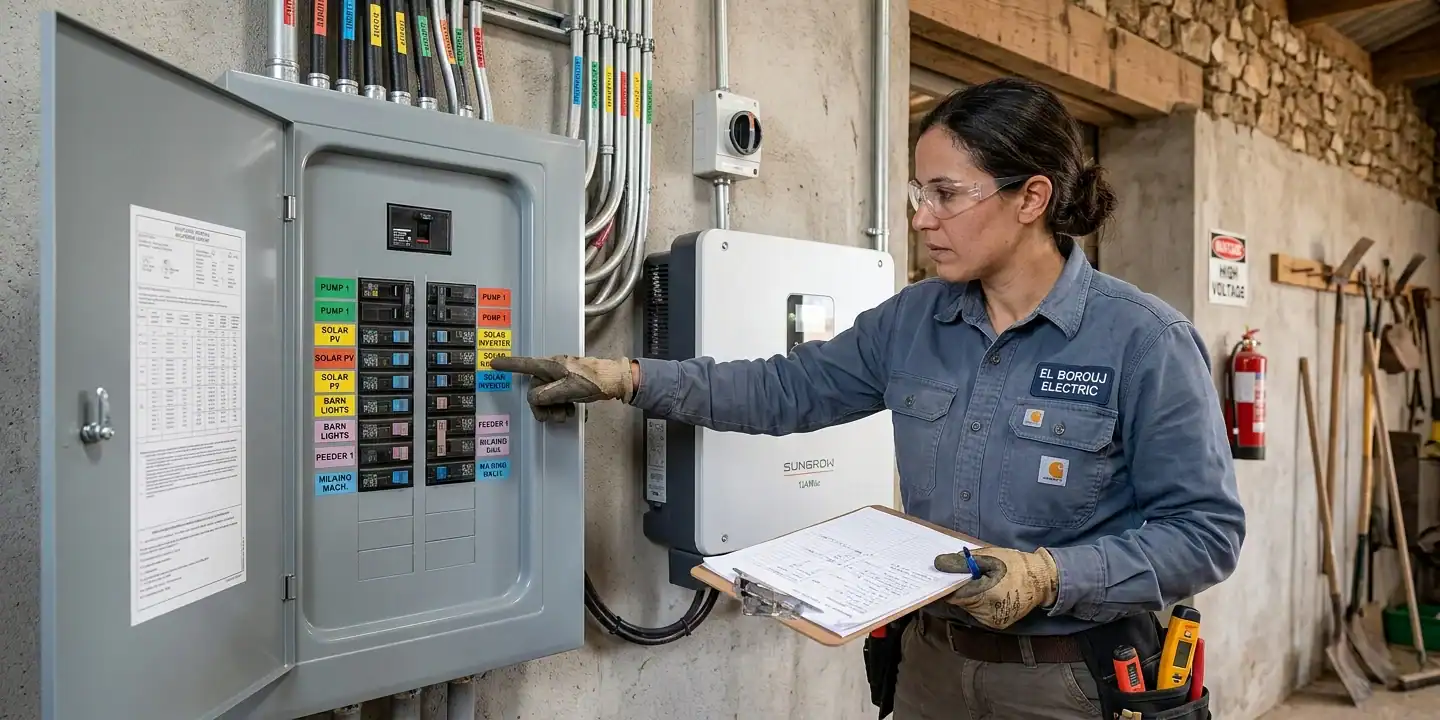
The 200-amp service panel is full. The busbar rating does not allow the solar backfeed required by the National Electrical Code. The utility transformer serving the farm is at capacity and cannot accept additional backfeed without upgrade.
The project stops. The service upgrade adds $8,000 to $30,000 to the cost and three to six months to the timeline. If the delay pushes the placed-in-service date past a tax credit deadline, the loss is measured in tens of thousands of dollars more.
This is the most common preventable failure in farm solar projects, and it happens because service capacity is rarely assessed until after the contract is signed.
The underlying technical issue is straightforward. The National Electrical Code limits the amount of solar backfeed that can be connected to a service panel. The standard rule — the 120% rule — states that the sum of the main breaker rating plus the solar backfeed breaker rating cannot exceed 120% of the panel’s busbar rating.
On a 200-amp panel with a 200-amp busbar, the calculation is:
200 A × 1.20 = 240 A maximum combined
240 A – 200 A main breaker = 40 A available for solar backfeed
Forty amps at 240 volts is 9.6 kW. Any solar system larger than 9.6 kW cannot be connected to that panel under the standard rule.
This is the constraint that stops farm solar projects. A 100 kW system requires 417 amps of backfeed capacity at 240 volts — more than ten times what the standard panel allows.
The Solution: Three Upgrade Scenarios and Three Avoidance Strategies
When the standard 120% rule cannot accommodate the system, there are six options. Three involve upgrading infrastructure. Three involve designing around the constraint.
The Three Upgrade Scenarios
Upgrade 1 — Main Panel Replacement
Replace the existing service panel with a larger one, typically increasing the busbar rating from 200 A to 400 A or higher.
When required: The existing panel busbar rating is the limiting factor, but the service entrance conductors and the utility supply are adequate.
Typical cost: $3,000 to $8,000 including labor, new panel, and breakers.
Timeline: One to three days.
Upgrade 2 — Service Entrance Upgrade
Increase the service capacity from 200 A to 400 A, which requires replacing the service entrance conductors, the meter base, and often the panel.
When required: The existing service conductors and meter base cannot support the increased capacity, typically because the farm’s total load has grown or the existing installation is old.
Typical cost: $8,000 to $18,000 including conductors, meter base, panel, and utility coordination.
Timeline: Two to six weeks, including utility disconnect and reconnect.
Upgrade 3 — Utility Transformer Upgrade
Increase the capacity of the transformer serving the farm, or install a dedicated transformer for the solar interconnection.
When required: The existing transformer is at or near capacity, or the utility’s distribution circuit cannot accept the additional backfeed.
Typical cost: $15,000 to $50,000, often customer-funded, depending on utility tariff and distance to the nearest suitable transformer.
Timeline: Three to nine months, including utility engineering review, equipment procurement, and scheduled outage work.
The Three Avoidance Strategies
Strategy 1 — Line-Side Tap (Supply-Side Connection)
Connect the solar system to the line side of the main disconnect rather than to a dedicated backfeed breaker in the panel. This bypasses the 120% rule entirely because the solar interconnection is not on the load side of the main breaker.
When it works: Most service configurations, subject to the authority having jurisdiction (AHJ) and utility approval.
Advantages: Avoids panel replacement entirely. Allows solar systems of any size to be interconnected without panel upgrade.
Disadvantages: Requires a visible disconnect and often a separate enclosure. Some AHJs and utilities do not permit line-side taps for solar, or require additional equipment. Requires coordination with the utility because the connection point is ahead of the meter in some configurations.
Typical cost: $1,500 to $4,000 in additional equipment and labor, compared to $3,000 to $18,000 for a panel or service upgrade.
This is the strategy most installers never offer. It requires more design work and more AHJ coordination than a standard backfeed breaker, so installers default to the panel upgrade because it is simpler for them — even when the line-side tap would save the customer $10,000 or more.
Strategy 2 — Reduced System Size
Size the solar system to fit within the panel’s available backfeed capacity under the 120% rule.
When it works: When the target system size can be reduced without materially affecting project economics — usually because the farm’s self-consumption rate is high and export capacity is not the limiting factor.
Advantages: No infrastructure cost. Fastest path to installation.
Disadvantages: Caps system size at the panel’s backfeed limit. On a 200-amp panel, the limit is typically 9.6 kW — far below what most farm projects require.
Practical note: This strategy is rarely viable for farm projects, because farm system sizes are typically 50 kW or larger. It applies primarily to small farm shop or outbuilding systems.
Strategy 3 — Multiple Interconnection Points
Divide the solar system into multiple smaller systems, each interconnected at a separate service point.
When it works: Farms with multiple buildings, each with its own service panel.
Advantages: Uses existing infrastructure. Each subsystem fits within its panel’s backfeed limit.
Disadvantages: Requires multiple inverters and multiple interconnection points. Increases complexity and monitoring overhead. Not applicable to single-service farms.
The Numbers Behind the Success: Cost Comparison for a 100 kW Farm System
Assumptions:
- System size: 100 kW
- Existing service: 200 A, 240 V single-phase, 200 A busbar
- Standard backfeed capacity: 9.6 kW (insufficient)
- Utility transformer: adequate capacity, no transformer upgrade needed
| Option | Cost | Timeline | Notes |
|---|---|---|---|
| Main panel replacement (200 A → 400 A busbar) | $6,000 | 1 – 3 days | Simplest upgrade, works if service entrance is adequate |
| Service entrance upgrade (200 A → 400 A) | $14,000 | 2 – 6 weeks | Required if service conductors are inadequate |
| Transformer upgrade | $28,000 | 3 – 9 months | Not required in this scenario, shown for reference |
| Line-side tap | $3,000 | 1 – 2 weeks | Avoids all panel and service upgrades |
| Reduced system size (9.6 kW) | $0 | 0 | Project economics collapse at this size |
| Multiple interconnection points | $8,000 | 3 – 5 weeks | Requires multiple buildings with separate services |
The line-side tap saves $3,000 to $11,000 compared with the panel or service upgrade, and completes in a fraction of the time.
Impact on Project Economics
Scenario A — Service upgrade required, no avoidance:
| Item | Amount |
|---|---|
| Solar system (100 kW) | $160,000 |
| Federal ITC (30%) | –$48,000 |
| Service upgrade (200 A → 400 A) | $14,000 |
| Net project cost | $126,000 |
| Annual savings (150,000 kWh at $0.12) | $18,000 |
| Simple payback | 7.0 years |
Scenario B — Line-side tap, no service upgrade:
| Item | Amount |
|---|---|
| Solar system (100 kW) | $160,000 |
| Federal ITC (30%) | –$48,000 |
| Line-side tap equipment and labor | $3,000 |
| Net project cost | $115,000 |
| Annual savings (150,000 kWh at $0.12) | $18,000 |
| Simple payback | 6.4 years |
The line-side tap improves the payback period by 0.6 years and reduces net project cost by $11,000.
And it protects the timeline. A service upgrade takes two to six weeks at best, and utility transformer work takes three to nine months. If those delays push the project past the December 31, 2027 placed-in-service deadline, the loss is the entire $48,000 ITC — not just the upgrade cost.
Expert Tips
1. Ask your installer directly whether a line-side tap is feasible. This is the single highest-value question in the pre-design phase. Most installers default to panel replacement because it is simpler. The line-side tap requires more design work and more AHJ coordination, but it saves the customer thousands. If your installer has never proposed one, ask why.
2. Get the service assessment before signing the contract. Do not accept a verbal assurance that the service is adequate. Request a written service assessment that documents the panel busbar rating, main breaker rating, available backfeed capacity, service conductor size, and transformer capacity. This should be part of the pre-contract site survey.
3. Confirm the utility’s position on line-side taps before designing around one. Utilities vary in their acceptance of supply-side connections. Some require a separate visible disconnect, some require utility-owned metering on the solar side, and some decline supply-side connections entirely. A 20-minute call to the utility interconnection department resolves this before design work begins.
4. If a service upgrade is required, coordinate the utility disconnect early. The utility must disconnect service to allow the upgrade work, and reconnect afterward. Utility scheduling delays are a common cause of project slippage. Schedule the disconnect as early as possible in the project timeline.
5. Confirm whether the utility or the customer funds the transformer upgrade. In many jurisdictions, the customer funds transformer upgrades required to serve new load or backfeed. In others, the utility funds it as part of normal system improvements. The difference can be $25,000 or more. Confirm the tariff treatment before committing to a project that requires transformer work.
6. Watch for the “dedicated transformer” alternative. Some utilities will allow a customer to install a dedicated transformer for the solar interconnection at the customer’s expense, rather than upgrading the shared transformer. This can be faster and cheaper than a shared upgrade, but the utility must agree.
7. Build the service assessment into your project timeline explicitly. If a service upgrade is required, add two to six weeks for a panel or service upgrade, and three to nine months for a transformer upgrade. If your project timeline assumes no upgrade and one turns out to be necessary, the timeline slips — and the tax credit deadline does not.
Conclusion
Half of all farm solar projects require an electrical service upgrade, and the cost is $8,000 to $30,000 plus two to four months of delay. But the upgrade is often avoidable.
The standard 120% rule limits backfeed capacity on a 200-amp panel to roughly 9.6 kW — far below what any farm-scale system requires. The three upgrade paths address the constraint by increasing capacity. The three avoidance strategies design around it.
The line-side tap is the most valuable avoidance strategy and the one most installers never propose. It bypasses the 120% rule, eliminates the panel upgrade, and completes in one to two weeks instead of six to nine months. On a 100 kW system, it saves $11,000 compared with a service upgrade and improves the payback period by 0.6 years. More importantly, it protects the project timeline, which protects the federal tax credit.
The action step is simple: before signing any contract, request a written service assessment and ask specifically whether a line-side tap is feasible for your service configuration.
Frequently Asked Questions
Q: Do I need a service panel upgrade for solar?
A: It depends on your system size relative to your service capacity. The National Electrical Code 120% rule limits solar backfeed on a 200-amp panel with a 200-amp busbar to roughly 40 amps, or about 9.6 kW. Most farm solar systems exceed this significantly, which means either a service upgrade or an alternative interconnection method. However, a supply-side (line-side) connection can often avoid the upgrade entirely by connecting ahead of the main breaker. A written service assessment should be part of any pre-contract site survey.
Q: How much does an electrical panel upgrade cost for solar?
A: Costs vary by scope. A main panel replacement typically costs $3,000 to $8,000. A full service entrance upgrade from 200 amps to 400 amps costs $8,000 to $18,000, including conductors, meter base, and utility coordination. A utility transformer upgrade costs $15,000 to $50,000, and is often customer-funded depending on the utility tariff. By comparison, a line-side tap typically costs $1,500 to $4,000 in additional equipment and labor — substantially less than any panel or service upgrade.
Q: Can I install solar without upgrading my electrical panel?
A: Often yes, using a supply-side or line-side connection. This method connects the solar system to the line side of the main disconnect rather than through a dedicated backfeed breaker in the panel, which bypasses the 120% rule entirely. It is permitted in many jurisdictions but requires approval from the local authority having jurisdiction and, in many cases, from the utility. It typically requires a visible disconnect and sometimes a separate enclosure. Most installers default to panel upgrades because they are simpler to design, so you may need to ask specifically about supply-side connections.
Related Articles
- How to Size a Solar System for Your Farm Shop and Power Tools — Load analysis that determines service capacity requirements.
- Farm Solar Permitting & Interconnection: The 2026 Timeline Guide — Where the service assessment fits in the project timeline.
- Adding Solar to an Existing Farm System: The 2026 Expansion Guide — The same constraint applied to expansion projects.
© 2026 Farm Solar Guide. All data sourced from ASAE water system standards, manufacturer cold-temperature specifications, EIA fuel price projections, and documented US farm operations. Last verified: October 22, 2026.